




From Minneapolis to the Stars
Anil Menon, born to a father from India and a mother from Ukraine, has a resume that seems tailor-made for the rigours of space. A graduate of Harvard and Stanford, he is a physician specialising in emergency and aerospace medicine, a mechanical engineer,
and a colonel in the U.S. Space Force. Before being selected as an astronaut in 2021, Menon had already carved out a significant career in space exploration. He was SpaceX's first-ever flight surgeon, where he helped build the medical program for the company's historic first human flights. He also served as a NASA flight surgeon, supporting crews on the International Space Station (ISS) from the ground. His extensive experience includes being a first responder to earthquakes in Haiti and Nepal, showcasing his expertise in high-stakes, extreme environments.
The Orbital Laboratory
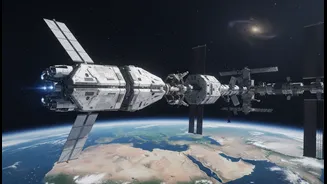
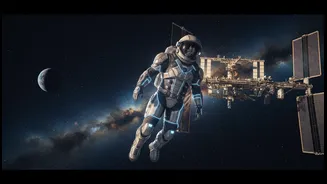
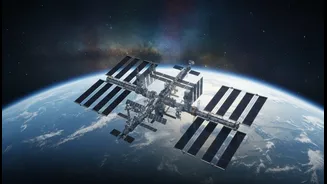
On July 14, 2026, Menon launched aboard a Soyuz spacecraft for an eight-month mission on the International Space Station. The headline's term "orbital tests" refers to the array of scientific investigations and technology demonstrations he will conduct. The ISS is a unique laboratory where the effects of microgravity on human health, materials, and technology can be studied in ways impossible on Earth. These experiments are crucial for planning long-duration deep-space missions, like those intended for Mars. For nearly a quarter-century, the ISS has been continuously inhabited, serving as a testbed for advancing the scientific knowledge needed for humanity to push farther into the cosmos.
Solving Deep-Space Challenges
Venturing far from Earth presents immense challenges, particularly in navigation and crew health. Missions to the Moon and Mars won't have the luxury of real-time support from Mission Control due to significant communication delays. Furthermore, tracking spacecraft accurately across millions of kilometres requires incredibly precise technology. NASA's Deep Space Network (DSN), a global array of giant radio antennas, is the backbone of this effort, but it relies on constant innovation. Medically, astronauts on a three-year Mars mission must be able to handle emergencies autonomously. This is where Menon's specific research becomes vital.
Menon’s Mission: Paving the Way for Mars
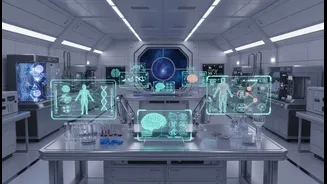
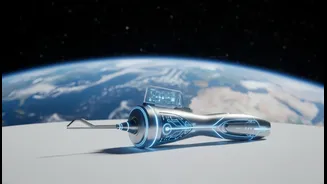
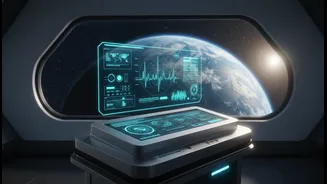
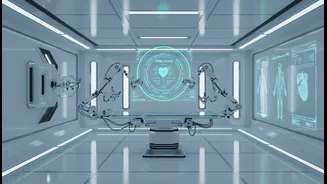
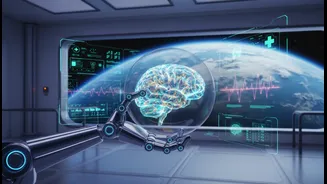
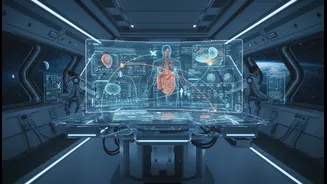
A significant part of Menon's work on the ISS directly addresses these deep-space problems. He will conduct ultrasound investigations using augmented reality and AI, a technology that could allow astronauts to diagnose medical issues without a doctor on Earth guiding them in real-time. He is also helping test a system to produce intravenous (IV) fluids from the station's drinking water, a critical capability for missions where carrying extensive medical supplies is not feasible. Other experiments include studying the effects of microgravity on blood flow and bioprinting vascular tissue, which provides crucial data on how to keep astronauts healthy on long journeys. This work essentially serves as a 'dress rehearsal' for the medical autonomy required for a trip to Mars.
Beyond Medicine: Technology for the Future
Menon’s role isn't limited to medicine. His research into the in-space production of semiconductor crystals could revolutionize high-performance computing and artificial intelligence, technologies essential for advanced spacecraft navigation and autonomous systems. By refining how these materials are made in microgravity, his work could lead to more powerful and efficient components for future ships that must 'think' for themselves. Every experiment, whether it's testing a new medical device or a manufacturing technique, generates data that helps engineers refine the tracking, communication, and life-support systems needed for humanity's next giant leap.