


The Old 'Goldilocks' Map
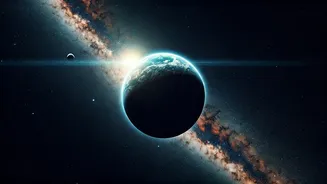
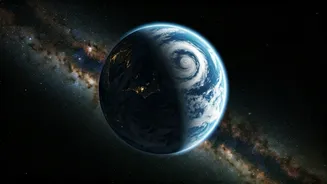
For decades, the search for life-bearing planets has been guided by a simple idea: the habitable zone, often called the 'Goldilocks zone'. This is the region around a star where conditions are just right—not too hot, not too cold—for liquid water to exist
on a planet's surface. This concept has been a useful first filter, helping astronomers prioritise which of the thousands of known exoplanets to study more closely. The logic is straightforward: since life as we know it depends on liquid water, we should look for worlds where water could flow freely. This has led to an exciting list of 'potentially habitable' worlds that orbit their stars within this temperate band. But as our tools and understanding have grown, so has the realisation that this simple definition might be both too broad and too narrow.
Why the Simple Label Fails
The habitable zone concept has a big problem: it considers only the distance from the star, not the planet itself. Our own solar system is a perfect example. Venus, Earth, and Mars all exist within or near the Sun's habitable zone. Yet, Venus is a scorching greenhouse inferno, Mars is a cold, barren desert with a thin atmosphere, and only Earth is a vibrant oasis. Being in the right place isn't enough. Furthermore, moons with subsurface oceans, like Jupiter's Europa or Saturn's Enceladus, exist far outside the traditional habitable zone, yet could potentially harbour life thanks to heat from tidal forces. The type of star also matters immensely. Red dwarfs, the most common type of star, have habitable zones very close to them, which could expose orbiting planets to intense radiation and solar flares, potentially stripping them of their atmospheres.
Reading the Atmosphere's Fingerprint
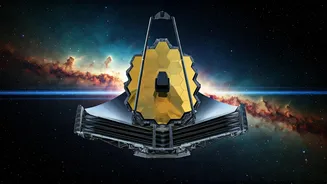
To truly understand an alien world, scientists are moving beyond location and focusing on what its atmosphere is made of. Using a technique called spectroscopy, astronomers can analyze the light from a star as it passes through a planet's atmosphere. Molecules in the atmosphere absorb specific wavelengths of light, leaving behind a unique barcode-like pattern of dark lines. These 'absorption lines' act as chemical fingerprints, revealing the presence of gases like water vapour, methane, carbon dioxide, and oxygen. Powerful tools like the James Webb Space Telescope (JWST) are designed specifically for this task, allowing for an unprecedented level of detail in characterising these distant skies. This moves us from simply guessing about habitability to measuring the actual ingredients present on a world.
A New Spectrum of Worlds
As we gather more atmospheric data, we are discovering a zoo of planet types that defy easy categorisation. We've found 'hot Jupiters', gas giants orbiting perilously close to their stars, and 'super-Earths', rocky worlds larger than our own. Some planets may have atmospheres rich in hydrogen, so-called 'Hycean' worlds, where the traditional signs of life, like oxygen, wouldn't be stable. On these worlds, scientists are looking for other potential biosignatures—gases produced by life—such as dimethyl sulfide, which on Earth is produced by marine life. The detection of such a gas on the exoplanet K2-18b, while preliminary, shows how the search is expanding to consider truly alien environments. Researchers are now proposing new classification systems based on a planet's temperature, mass, density, and atmospheric chemistry to create a more meaningful map of the cosmos.
The Future of Planet Hunting
The transition from discovering planets to characterising them is a new frontier in astronomy. Upcoming missions like ESA's Ariel are designed to survey the atmospheres of about 1000 exoplanets, providing a massive dataset for comparison. This will allow scientists to study exoplanet atmospheres not just individually, but as populations, identifying trends and patterns that will help refine theories of planet formation and evolution. The ultimate goal is to find biosignatures—combinations of gases that are unlikely to exist without a biological source. However, scientists are cautious. Interpreting these signals is complex, as non-biological processes can sometimes mimic the signs of life, creating 'false positives'. Untangling these ambiguities will require more sophisticated models and, eventually, even more powerful next-generation telescopes.