




The universe is filled with mysteries, but none is more profound than dark matter. This invisible substance makes up most of the cosmos, yet we don't know what it is. Now, researchers are using light from the dawn of time to test a wild idea.
The Universe’s Ancient Light
Imagine being
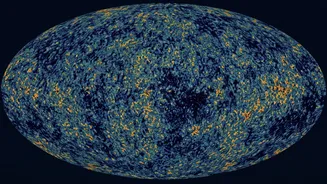
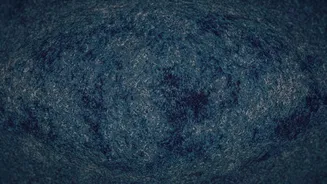
able to see a snapshot of the universe when it was just 380,000 years old. That's what the Cosmic Microwave Background (CMB) is. It's the faint, residual light from the Big Bang, a thermal afterglow that permeates all of space. For cosmologists, the CMB is a treasure map. Its tiny temperature fluctuations from one patch of the sky to another reveal how matter was distributed in the infant universe, providing the seeds for all the galaxies we see today. This 'fossil radiation' is one of the most powerful tools scientists have to study the origins and evolution of the cosmos.
The Dark Matter Dilemma
For decades, astronomers have been confronted with a gravitational puzzle. Galaxies spin faster than they should, and clusters of galaxies hold together when they ought to fly apart. The only explanation that fits these observations is the existence of an unseen mass: dark matter. It's thought to make up about 85% of all matter in the universe, but it doesn't interact with light, making it completely invisible. While the leading theory suggests it's made of undiscovered subatomic particles, another, older idea has been making a comeback: what if it's made of black holes?
Primordial Black Holes: An Old Idea
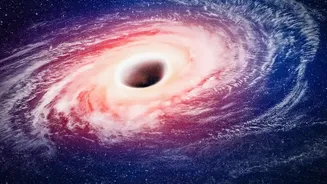
Not just any black holes, but primordial black holes (PBHs). First proposed by Stephen Hawking and others, these are hypothetical black holes that could have formed in the first fractions of a second after the Big Bang. Unlike black holes that form from collapsing stars, PBHs could have been created by intense pressure fluctuations in the dense, hot early universe, potentially spanning a huge range of sizes, from the mass of an asteroid to billions of times the mass of our sun. If they existed, they would be an ideal candidate for dark matter: they are massive, don't emit light, and have been around since the beginning.
Using the CMB to Hunt for Giants
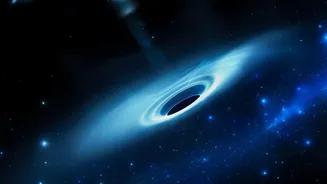
Recently, researchers decided to test a specific version of this theory. What if dark matter consisted of 'stupendously large black holes' (SLABs), hypothetical giants more than 100 billion times the mass of the sun? The logic is that if dark matter were made of these behemoths instead of a fine, evenly spread 'dust' of particles, the universe would have a 'grainy' texture on a massive scale. This graininess would leave a distinct mark on the Cosmic Microwave Background. A giant black hole would cast a 'shadow' against the CMB, a deficit in the background light that telescopes should be able to detect. By analyzing the smoothness of the CMB data, scientists can effectively check if these giant objects are out there.
What the Research Found
After analyzing patterns in the Cosmic Microwave Background, researchers found it was too smooth. The CMB lacked the specific 'graininess' that would be expected if a significant portion of dark matter was made of these stupendously large black holes. This result doesn't mean these monster black holes can't exist at all, but it does strongly suggest they are not the primary component of dark matter. The study places tight constraints, effectively ruling out this particular hypothesis and forcing scientists to look elsewhere. It’s a powerful example of how even a null result—not finding something—is a critical part of the scientific process.