




Euclid Finds the Universe's Oldest Lighthouses
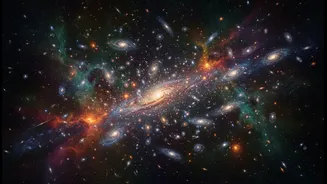
Imagine looking back in time so far that the universe is just a toddler. That's what the European Space Agency's Euclid telescope has just done. In early July 2026, astronomers announced Euclid had discovered 31 of the most ancient quasars ever seen.
Quasars are the intensely bright cores of distant galaxies, powered by supermassive black holes gobbling up surrounding matter. They shine with the light of a trillion suns, acting as cosmic lighthouses that illuminate the universe's infancy. Two of these newfound quasars are the most ancient ever observed, with their light originating when the cosmos was just 670 million years old, a mere 5% of its current age. This discovery more than doubles the number of known quasars from this primordial era and deepens a major puzzle: how did these billion-solar-mass black holes grow so massive, so fast, at the dawn of time?. The finding is a game-changer, helping scientists map the end of the cosmic 'dark ages' and understand the formation of the very first giant structures.
Webb's Anniversary Portrait of a Galactic Collision
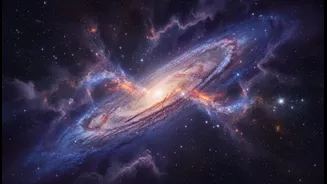
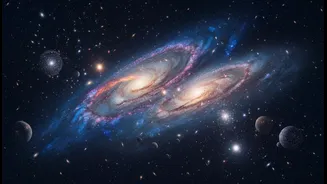
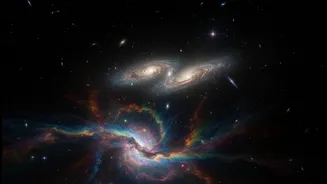
To mark its fourth year of science operations in July 2026, the James Webb Space Telescope (JWST) released a breathtaking new portrait of Centaurus A, a galaxy just 11 million light-years away. What makes this image so stunning is not just its beauty, but the violent history it reveals. Webb's infrared cameras pierced through thick lanes of dust that have long hidden the galaxy's core, uncovering a densely packed tapestry of millions of individual stars. Centaurus A is the aftermath of a colossal collision between two galaxies that occurred about two billion years ago. The images show the scars of this merger, including a warped, parallelogram-shaped disk of gas and dust at its center. By resolving individual stars, astronomers can now perform 'galactic archaeology,' determining which stars existed before the crash and which were born in the chaotic aftermath. Webb’s view also details how the galaxy's central supermassive black hole is actively influencing its evolution, both triggering and suppressing star formation in a cosmic tug-of-war.
A New Planet Hunter Prepares to Launch
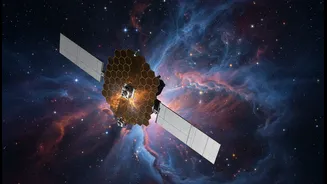
While Webb and Euclid rewrite the story of the distant universe, another powerful observatory is preparing for its mission. NASA's Nancy Grace Roman Space Telescope, which arrived at its Florida launch site in June 2026, is on track to launch as early as August 2026. This isn't just another telescope; it's a cosmic census-taker. Roman is designed to change the scale of exoplanet discovery. While Webb studies targets in detail, Roman will conduct vast, sweeping surveys of the sky. Its field of view will be at least 100 times larger than Hubble's, allowing it to monitor hundreds of millions of stars. Scientists predict that in a single mission, Roman could discover around 100,000 new exoplanets, which is more than every telescope in history has found combined. It will use two primary methods: detecting the slight dimming of a star as a planet passes in front, and a technique called microlensing, which can find planets far from their stars, or even 'rogue' planets that don't orbit any star at all. It will be a flagship mission to explore dark energy and the exoplanet frontier.