





Seeing the Unseeable
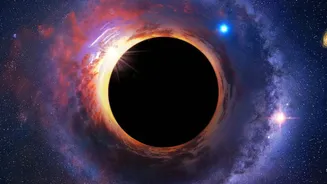
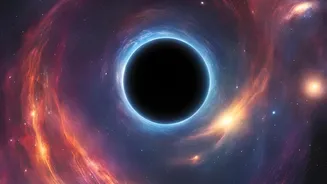
Until recently, black holes were mostly theoretical concepts, their existence inferred but never directly seen. The classic image was of a cosmic vacuum cleaner, a dead end for matter and light. That picture began to change dramatically with breakthroughs
like the Event Horizon Telescope (EHT) and the James Webb Space Telescope (JWST). In 2019, the EHT collaboration unveiled the first-ever image of a black hole's silhouette in the M87 galaxy, a monumental achievement that turned an abstract idea into a visible reality. This global network of radio telescopes created a virtual, planet-sized observatory capable of resolving the event horizon itself. These new tools have allowed astronomers to move beyond simply knowing black holes exist to actively studying their behaviour and environment with unprecedented detail.
The Cosmic Chicken-and-Egg Problem
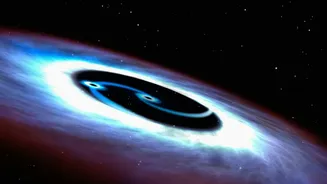
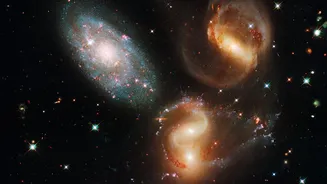
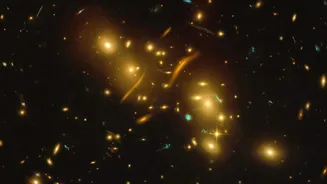
One of the longest-standing questions in cosmology has been about the relationship between galaxies and the supermassive black holes (SMBHs) at their centres. The prevailing theory was that galaxies formed first, and over billions of years, stars would collapse and merge to gradually form a central black hole. However, observations from JWST have turned this model on its head. The powerful space telescope has discovered shockingly massive black holes that existed less than a billion years after the Big Bang. These 'infant' black holes are far too large to have formed through the slow, conventional process. For instance, one black hole, found in a galaxy called QSO1, clocks in at 50 million times the mass of our sun, existing just 700 million years after the universe began. This suggests black holes may not be a consequence of galaxy formation, but a prerequisite for it.
Architects of the Galaxies
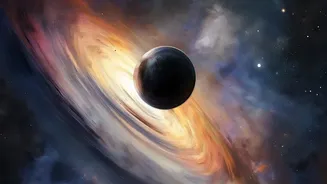
The new evidence points to a much more dynamic and influential role for black holes. Instead of being passive objects, SMBHs appear to be active 'engines' that shape their host galaxies. This process is known as 'AGN feedback', where the Active Galactic Nucleus—the furiously accreting black hole—releases enormous amounts of energy. Powerful jets and winds blast out from the black hole, heating and expelling gas from the galaxy. This can have two major effects. On one hand, it can compress gas clouds and trigger bursts of star formation. On the other, it can blow away the raw fuel needed for stars, effectively 'quenching' star formation and halting the galaxy's growth. This self-regulating relationship helps explain the observed correlation between a black hole's mass and the size of its host galaxy's central bulge.
Rewriting the Cosmic Blueprint
These discoveries are forcing cosmologists back to the drawing board. The existence of 'heavy' black hole 'seeds' in the early universe challenges standard models. Theories now being explored include the direct collapse of massive primordial gas clouds or even the possibility that some black holes are relics from a universe that existed before the Big Bang. These early, oversized black holes could help explain some of the universe's most profound mysteries, including the nature of dark matter. The 'Little Red Dots' frequently spotted by JWST in the early universe could be a new class of object—massive black holes cloaked in a dense shroud of gas, representing a key missing stage in their growth before they emerged as brilliant quasars. By studying these objects, scientists can refine their models to better reflect the chaotic and rapid development of the early cosmos.