






What Exactly Are Making Charges?
Making charges are the fees a jeweller adds to the price of gold to cover the cost of transforming it from a raw block into a finished product. This fee accounts for the labour, craftsmanship, design complexity, and even the minute wastage of gold that
occurs during the manufacturing process. These charges are not standardised and can be calculated in two main ways: as a fixed rate per gram of gold or as a percentage of the total gold value. Crucially, this cost is a one-time expense. When you decide to sell or exchange your gold, the making charges you paid are almost never recovered. The buyer will only pay for the value of the raw gold at the current market rate.
Making Charges on Gold Coins: The Investor's Choice
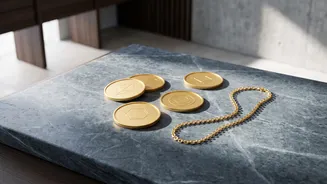
Gold coins are designed primarily for investment and savings. Since they require minimal craftsmanship—they are typically stamped by machines—their making charges are significantly lower than those for jewellery. The charges for gold coins can range from as low as 1% to about 11%, though some sources indicate a higher range of 8% to 16%. Coins bought from banks and certified dealers often have lower charges than those from jewellery stores. Because they are usually made of 24 Karat (99.9% pure) gold and have low initial costs, coins offer better financial returns and retain their value more effectively, making them the superior choice for pure investment.
Making Charges on Jewellery: The Cost of Craftsmanship
Jewellery is where making charges become a major component of the final price. These charges can range widely, from 8% for simple, machine-made items to over 30% for intricate, handcrafted designer pieces. Some highly ornate items from premium brands can even have making charges approaching 40% or more. The more complex the design, the higher the labour cost and therefore, the higher the making charges. While jewellery offers the immense pleasure of adornment and holds cultural significance, it is a less efficient form of investment. The high making charges mean you pay a significant premium over the gold's base value, a premium that you will not get back upon resale.
Don't Forget GST and Other Costs
Beyond making charges, your final bill will include the Goods and Services Tax (GST). In India, the value of the gold itself (whether in a coin or jewellery) attracts a 3% GST. Additionally, the making charges are considered a service and are taxed separately, typically at 5%. Some jewellers may present a single, consolidated bill where the entire amount is taxed at 3%, while others will provide an itemised bill showing the separate GST on making charges. Always ask for a detailed bill to understand the full cost breakdown. This transparency is key to ensuring you are being charged correctly.
The Real Test: Resale and Exchange Value
The true difference between buying coins and jewellery becomes starkly clear when you sell them. When you sell a gold coin, its value is determined almost entirely by its weight, purity (usually 24K), and the day's market rate. Since you paid very little in making charges, the resale value is very close to the market price of gold, making it a highly liquid asset. In contrast, when you sell jewellery, the significant making charges you paid are completely lost. A jeweller will melt down the ornament, assess its purity (often 22K or 18K), and pay you only for the net weight of the pure gold. This means a piece of jewellery can lose 10-25% of its initial purchase value instantly, simply due to the unrecoverable making charges.