



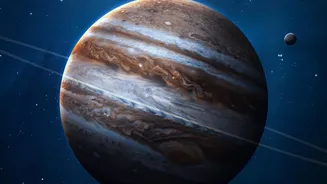
Finding the King of Planets
Jupiter is consistently one of the brightest objects in the night sky, outshone only by Venus and the Moon. Unlike stars, which twinkle, Jupiter glows with a steady, silvery light, making it easy to distinguish. To pinpoint its exact location, a simple
stargazing app on your phone can guide you. The best times to observe are in the months surrounding its 'opposition', a yearly event when Earth passes directly between Jupiter and the Sun, making the planet appear at its biggest and brightest. In 2026, Jupiter reaches opposition on January 10, making the winter months ideal for viewing.
Choosing the Right Binoculars
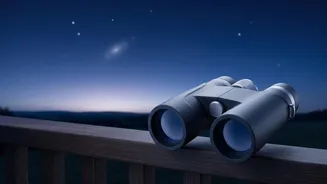
The term "good basic binoculars" isn't about high cost, but capability. Look for a pair marked with numbers like 7x50 or 10x50. The first number (7x or 10x) is the magnification, while the second (50) refers to the diameter of the main lenses in millimetres. Larger lenses gather more light, which is crucial for seeing faint objects. While more magnification might seem better, anything higher than 10x becomes very difficult to hold steady by hand. A standard pair of 10x50 binoculars is powerful enough to reveal Jupiter's most famous features.
The Secret to a Steady View
Hand-held shakiness is the biggest obstacle to getting a clear view of celestial objects. Every tiny tremor in your hands is magnified, turning a potentially sharp image into a frustrating blur. The simple solution is stabilization. You can brace your binoculars against a wall, a fence, or the roof of a car to get a much steadier image. For the best results, investing in an inexpensive tripod adapter is a game-changer. This allows you to mount your binoculars on any standard camera tripod, providing a perfectly stable platform for your observations.
Spotting the Galilean Moons
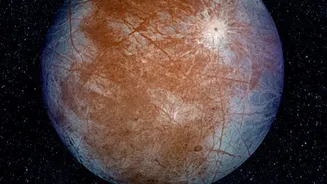
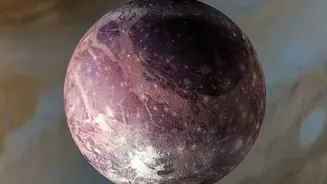
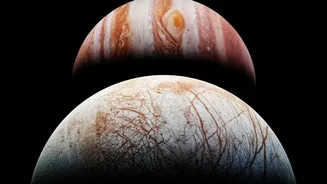
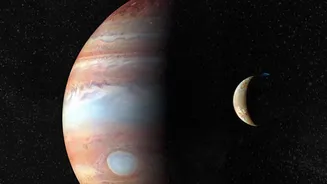
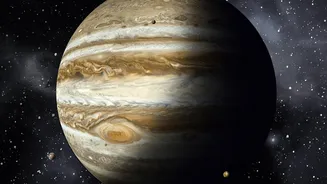
With your binoculars stabilized and pointed at Jupiter, you will see the planet as a small, bright disk. Look closely on either side of it for up to four tiny pinpricks of light, often arranged in a straight line. These are not stars; they are Io, Europa, Ganymede, and Callisto, Jupiter's four largest moons. Galileo Galilei first discovered them in 1610, and his observation that they orbited Jupiter helped shift our understanding of the solar system. On any given night, you might see two, three, or all four, as they can be hidden in front of or behind the planet during their orbit. Watching them change position from one night to the next is a fascinating exercise in celestial mechanics.
Glimpsing the Cloud Bands
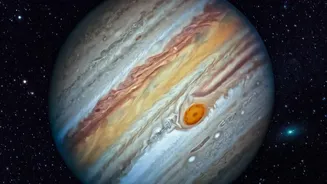
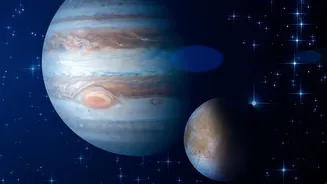
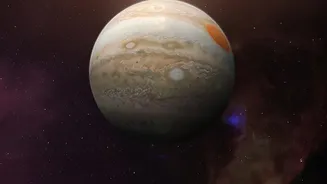
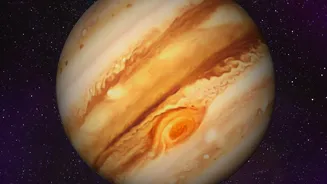
Seeing Jupiter's atmospheric bands—its dark belts and lighter zones—is more challenging with binoculars but not impossible. Under very clear, dark skies and with a steady view, you may be able to discern a hint of these features. Jupiter will not look like a perfect circle; its rapid 10-hour rotation causes it to bulge slightly at the equator. The two most prominent stripes you might glimpse are the North and South Equatorial Belts, which straddle the planet's equator. Seeing them requires patience and allowing your eyes time to adjust to the dark. Don't be discouraged if you can't see them on your first try; the experience of seeing the moons alone is a significant reward.