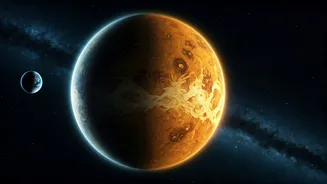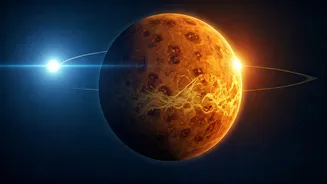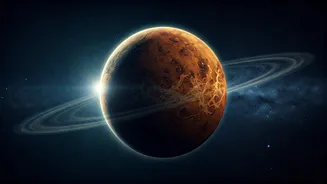

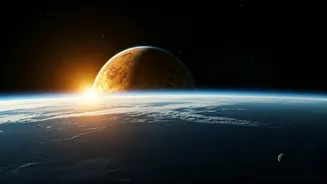
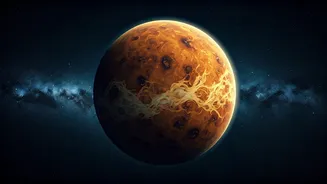
First, Let’s Define 'Day' and 'Year'
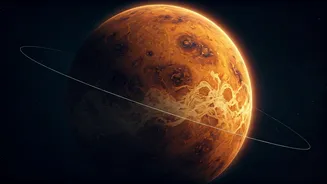
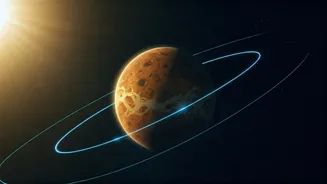
Before we dive into the weirdness, let's get our terms straight. A 'year' is simple: it's the time it takes a planet to complete one full orbit around the Sun. For Venus, this journey takes about 225 Earth days. So, a Venusian year is significantly shorter
than ours.A 'day' is the time it takes a planet to rotate once on its own axis. Here’s where Venus gets bizarre. One full rotation for Venus takes approximately 243 Earth days. So, you have a situation where the time it takes to spin once (a day) is longer than the time it takes to go around the Sun (a year). It’s the only planet in our solar system with this peculiar characteristic. If you stood on Venus, you'd complete a full trip around the Sun before the planet itself had finished a single spin.
The Slow, Backward Spin
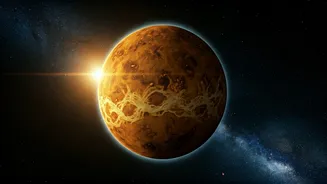
The core of this mystery lies in Venus’s rotation. Not only is it incredibly slow, but it’s also backward compared to most other planets. Earth and six of the other planets spin on their axis in a counter-clockwise direction, a motion known as prograde rotation. This means the Sun rises in the east and sets in the west.Venus, however, spins clockwise. This is called retrograde rotation. If you could survive on its surface, you would see the Sun rise in the west and set in the east. This backward spin is a crucial piece of the puzzle. But what caused our planetary neighbour to become such a cosmic nonconformist? Scientists believe it wasn’t always this way.
A Collision in the Distant Past?
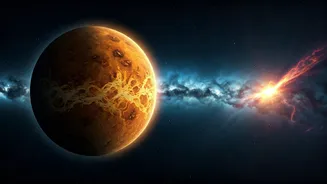
The leading theory for Venus's strange rotation points to a cataclysmic event deep in its history. In the chaotic early days of the solar system, when planet-sized objects were still careening through space, Venus may have suffered a colossal impact. A collision with a massive asteroid or another protoplanet could have been powerful enough to not just slow its original spin but actually reverse it, or even flip the planet completely upside down, making its rotation appear retrograde from our perspective.While direct evidence of such an impact is long gone, this hypothesis explains how a planet could end up with such an unusual rotational state. It paints a picture of a violent past that set Venus on a completely different evolutionary path from Earth.
The Crushing, Super-Rotating Atmosphere
A giant, ancient impact might have started the process, but Venus’s modern atmosphere is helping to keep it slow. Venus is shrouded in an incredibly dense atmosphere, about 90 times thicker than Earth's, composed mostly of carbon dioxide. This creates an intense greenhouse effect, making its surface the hottest in the solar system.More importantly, this thick blanket of gas is in a state of 'super-rotation'. The upper layers of the atmosphere whip around the planet at speeds exceeding 360 km/h, circling the entire globe in just four Earth days. This racing atmosphere creates powerful tidal forces and friction against the solid planet below, acting like a constant brake. Computer models show that this atmospheric drag is strong enough to significantly alter the planet's rotation over millions of years, contributing to its current leisurely pace.
So, What Is a 'Day' Really Like?
To make things even more confusing, the 'day' we’ve been discussing (243 Earth days) is a sidereal day—one full 360-degree rotation. But what about a solar day, the time from one sunrise to the next? Because Venus is rotating backward while it orbits the Sun, these two motions work against each other in a way that shortens the solar day. The time between sunrises on Venus is 'only' about 117 Earth days. This means that on Venus, you get roughly two sunrises for every one trip around the Sun. So, in a way, a Venusian year contains about two Venusian solar days, even though a single rotation takes longer than a year. It's a paradox wrapped in an enigma, hidden beneath a toxic, super-rotating sky.