



A Sweet Find in the Galactic Center
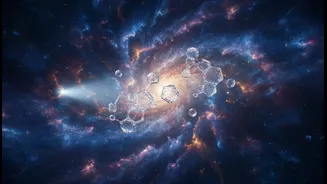
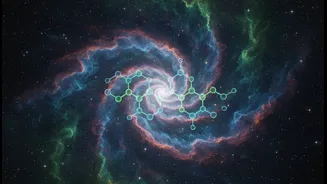
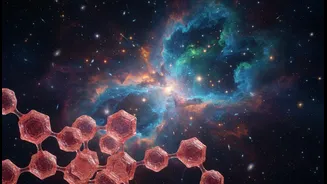
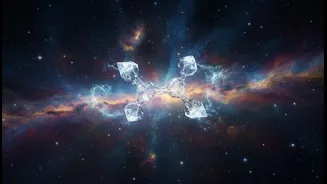
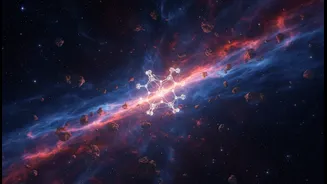
An international team of scientists has identified erythrulose, a four-carbon sugar, swirling within a molecular cloud named G+0.693-0.027. Located near the heart of the Milky Way, this cloud is a stellar nursery, a place where stars and planets are born.
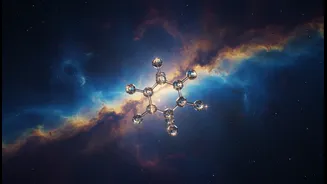
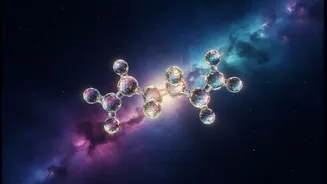
Using powerful radio telescopes in Spain, researchers pinpointed the chemical fingerprint of this sugar, which on Earth is found in fruits like raspberries. While other sugar-like molecules have been spotted in space before, often on meteorites or asteroids, this is the first time a 'true' sugar has been found floating freely in the interstellar medium — the raw material from which solar systems are made.
More Than Just a Sugar
So, why the excitement over a sprinkle of sugar 27,000 light-years away? Sugars are fundamental to life as we know it. They act as an energy source and, crucially, form the structural backbone of RNA and DNA, the molecules that carry genetic information. Erythrulose is a significant find because it belongs to the same chemical family as ribose, the sugar in RNA. Its discovery confirms that complex, life-sustaining molecules can form naturally in the cold, harsh conditions of deep space, long before planets even exist. This suggests that the universe is pre-stocked with some of the most basic ingredients for biology.
The Planet-Building Connection
The discovery of erythrulose in a molecular cloud directly connects the ingredients for life with the process of planet formation. These vast clouds of gas and dust are not just empty space; they are cosmic construction zones. The new research suggests that erythrulose forms on the surface of tiny dust grains within the cloud. These are the very same dust grains that clump together over millions of years, first forming pebbles, then rocks, and eventually entire planets. The finding implies that as planets like Earth form, they are built from materials that are already enriched with the chemical precursors to life. The processes are not separate; they are deeply intertwined from the very beginning.
Solving an Earthly Puzzle
This cosmic delivery service also helps solve a long-standing puzzle about the origin of life on our own planet. Scientists have struggled to explain how sufficient quantities of sugars could have formed on the volatile surface of the young Earth to kickstart biology; lab simulations have shown it to be an inefficient process. The discovery of abundant erythrulose in space provides a compelling alternative. Researchers estimate that during the 'Late Heavy Bombardment' period around four billion years ago, millions of tonnes of this sugar could have rained down on Earth via comets and asteroids, enriching the primordial soup with a ready-made supply of essential building blocks.
A New Recipe for Cosmic Chemistry
The discovery also upends some conventional wisdom about how complex molecules form in space. Scientists previously thought that larger molecules were built incrementally, adding one carbon atom at a time. However, the team found a surprising abundance of four-carbon erythrulose but very little trace of simpler three-carbon sugars. This suggests a different chemical pathway is at play, where two smaller two-carbon molecules, which are known to be plentiful in space, combine to create the four-carbon sugar. This new understanding of interstellar chemistry could help scientists predict what other complex molecules might be waiting to be discovered.