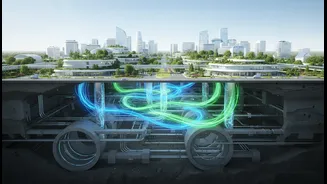








The Invisible Barrier Beneath Our Streets
When heavy rain hammers down on a city, we typically blame overwhelmed drainage systems and the vast expanses of concrete and asphalt that prevent water from soaking into the ground. While these are critical issues, new scientific attention is being paid
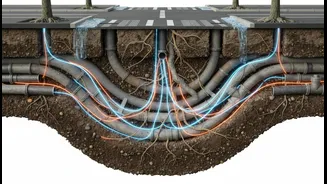
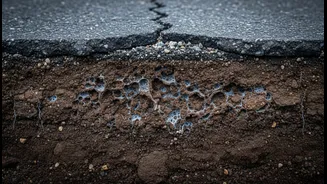
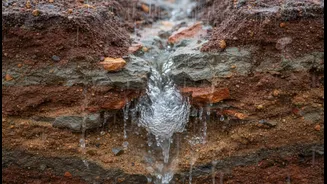
to a less obvious phenomenon: soil air pressure. The idea is that as rainwater tries to seep into the ground, it can trap air in the soil. This trapped air, with nowhere to go, can build up pressure and effectively push back against the infiltrating water, dramatically slowing down absorption and worsening surface flooding. It acts like an invisible, underground shield, preventing the ground from doing its job of soaking up the deluge.
How Trapped Air Worsens Flooding
Imagine trying to pour water into a bottle that has no air vent. After a certain point, the air inside prevents more water from entering. A similar principle applies to soil. In natural landscapes, soil has plenty of channels, like those from roots and worms, that allow air to escape as water enters. However, in cities, soil is often compacted and sealed under layers of pavement and buildings. During an intense downpour, water rapidly saturates the top layer of any exposed soil, creating a cap. The air beneath this cap gets compressed. As the air pressure builds, it can equal or even exceed the pressure of the water trying to push its way down. This significantly reduces the rate of infiltration, forcing more water to run off into streets and overburdened storm drains, leading to the flash floods that paralyse urban life.
What the Science Says
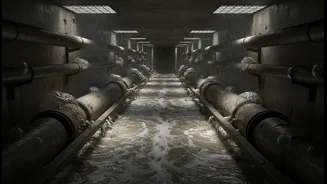
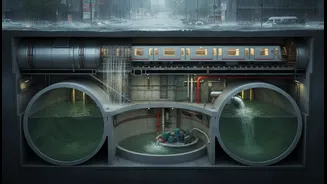
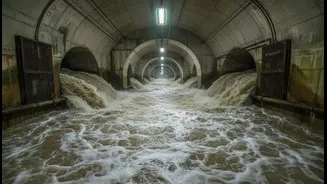
While the concept isn't entirely new, recent attention has brought it to the forefront of urban planning discussions. Hydrological studies have long shown that positive soil air pressures can markedly reduce water infiltration. Research using controlled experiments has demonstrated that even a small amount of air back-pressure—just a few millibars—can decrease infiltration rates by an order of magnitude. In a separate but related discovery, engineers at an underground research facility observed that massive amounts of water pouring down a shaft during a storm acted like a giant piston, pushing air and reversing ventilation patterns deep underground. This real-world observation highlights the powerful, and often underestimated, physical force that air movement can exert in subsurface environments.
Rethinking Urban Design for Airflow
This growing understanding could have profound implications for how we design our cities, especially in a flood-prone country like India. If trapped air is a major barrier to water absorption, then future flood management strategies must not only focus on managing water but also on managing air. This could involve designing more 'breathable' urban surfaces. Permeable pavements, which are already used to let water through, could be enhanced with subsurface ventilation systems. Urban planners might need to incorporate 'soil-venting' infrastructure, such as strategically placed pipes or channels that allow trapped air to escape during a storm. Green spaces like parks and rain gardens become even more critical, not just for holding water, but for providing large, unsealed areas where soil can breathe.
A Piece of a Larger Puzzle
It is crucial to understand that managing underground airflow is not a silver bullet for urban flooding. The primary causes remain rapid, unplanned urbanisation, the loss of natural water bodies and green cover, and increasingly intense rainfall due to climate change. Effective flood resilience requires a multi-pronged approach, combining traditional 'grey' infrastructure like drains and tunnels with 'blue-green' solutions like restoring lakes and creating interconnected green corridors. However, acknowledging the role of soil air pressure adds a vital and previously overlooked dimension to the challenge. By considering how the ground beneath our cities breathes, engineers and planners can develop more holistic and effective strategies to keep our urban centres dry and functional, even in the face of extreme weather.