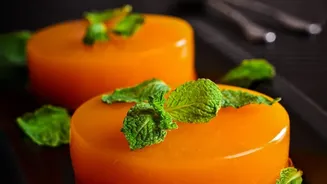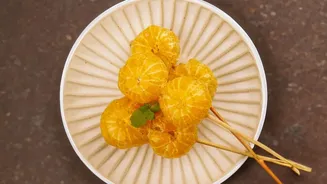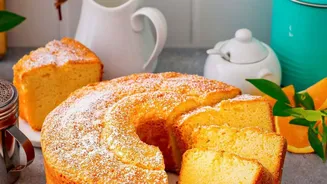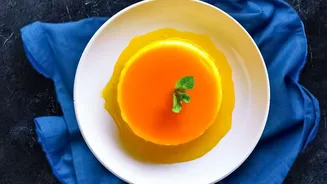



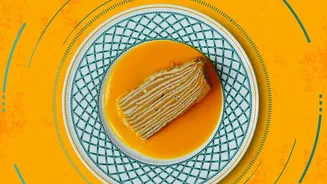
A beautiful orange dessert deserves a show-stopping finish. Using the whole fruit as a garnish not only adds visual appeal but also enhances flavor. It’s the secret to taking your baking from simply delicious to truly unforgettable.
The Beauty of Whole Fruit
Finishing a dessert
with a thoughtful garnish is more than just decoration; it's an extension of the dish itself. When it comes to oranges, the entire fruit is a treasure trove of flavour, colour, and aroma. From the intensely fragrant zest to the jewel-like segments of flesh, using the whole orange is a sustainable and sophisticated approach. A well-chosen garnish hints at the flavours within, whether it’s a rich chocolate and orange torte or a light, citrusy panna cotta. It transforms a simple dessert into a polished, professional-looking creation.
Candied Orange Slices
Perhaps the most elegant of orange garnishes, candied slices look like stained glass and offer a delightfully chewy texture. The process is simple, requiring only oranges, sugar, and water. Start by slicing an orange into thin, uniform rounds, about 1/4-inch thick. A brief boil in water helps to remove any bitterness from the pith. Afterwards, the slices are simmered gently in a simple syrup of sugar and water for 45 to 60 minutes, until the rinds become translucent. Once cooked, carefully transfer them to a wire rack to dry. This can take up to 24 hours at room temperature, but the process can be sped up in a low oven. The result is a glistening, edible jewel perfect for adorning cakes, tarts, and even cocktails.
Dehydrated Orange Wheels
For a more rustic and aromatic garnish, dehydrated orange wheels are an excellent choice. They are deceptively simple to make, requiring only an oven or a food dehydrator. Slice oranges as thinly and evenly as possible—a mandoline is ideal for this task to achieve consistent 1/8 to 1/4-inch thickness. Arrange the slices in a single layer on a parchment-lined baking sheet placed on a wire rack. Bake them in an oven set to a very low temperature, around 170-200°F, for several hours. The process can take anywhere from 3 to 9 hours, depending on the thickness of the slices and the type of fruit. Flip them occasionally to ensure they dry evenly. The wheels are done when they are completely dry and brittle to the touch. Stored in an airtight container, these fragrant garnishes last for months and are perfect for cakes, mulled drinks, and even holiday garlands.
The Classic Orange Twist
A staple in mixology, the orange twist is just as effective on desserts. A twist isn't just for looks; squeezing it releases fragrant essential oils from the peel, adding a burst of fresh citrus aroma. To create one, use a channel knife or a sharp paring knife to cut a long, thin strip of orange peel, being careful to avoid the bitter white pith underneath. For a perfect spiral, you can wrap the peel tightly around a straw or skewer, hold it for a few seconds to set the shape, and then release. This elegant flourish adds a professional touch to mousses, custards, and cheesecakes, providing a hit of scent just before the first bite.
Elegant Segments and Zest
Sometimes the most refined garnish is the simplest. Supreming an orange—the technique of cutting away the peel, pith, and membrane to produce perfect, jewel-like segments—offers pure fruit flavour without any chewiness. To do this, slice the top and bottom off the orange, then stand it on a cutting board. Carefully slice away the peel and white pith, following the curve of the fruit. Then, with a sharp paring knife, cut between the membranes to release each segment. These beautiful segments can be arranged on top of cakes or alongside creamy desserts like panna cotta. Don't forget about zest. Long, wide strips of zest add visual drama, while finely grated zest infused into sugar can be sprinkled over a finished dessert for a final layer of flavour.