




A World Built for Flight
Titan is an alien world that is, in some ways, strangely similar to a primitive Earth. It is the only moon in our solar system with a thick atmosphere, primarily made of nitrogen like our own. It has weather, clouds, and rain, but instead of water, liquid
methane and ethane carve rivers into a surface of water ice and flow into vast lakes. This unique environment holds tantalizing clues about prebiotic chemistry—the steps that lead to life. The key to unlocking these secrets is mobility, and Titan’s physical properties make it uniquely suited for flight. Its atmosphere is about four times denser than Earth's, while its gravity is only one-seventh as strong. This combination of high atmospheric density and low gravity means it is far easier to generate lift, making it an ideal place for an aerial explorer.
The Limits of a Wheeled Rover
On a world like Titan, a traditional rover would face immense challenges. While Mars rovers have traveled dozens of kilometers over many years, their progress is slow and deliberate, limited by terrain. A rover on Titan would be stuck in one small region, unable to cross the vast organic sand dunes or investigate the shoreline of a methane sea hundreds of kilometers away. The goal of the Dragonfly mission is to explore multiple, diverse locations to understand how far the chemistry of life has progressed. This requires covering vast distances to sample different geologic settings, from the initial landing site to an impact crater where liquid water and organic materials may have mixed in the past. A wheeled vehicle simply could not travel far enough or fast enough to achieve these ambitious scientific objectives within a realistic mission timeline.
The Dragonfly Advantage: Leapfrogging Across an Alien Landscape
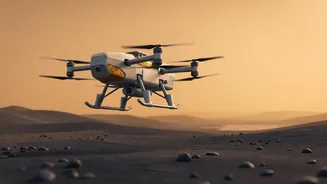
Enter Dragonfly, a dual-quadcopter that functions as a relocatable lander. Instead of driving, it will fly. During its planned multi-year mission, Dragonfly will perform a series of flights, or 'hops', from one site of interest to the next. Each flight could cover several kilometers in just a matter of minutes, a distance that would take a Mars rover days or weeks to travel. This allows the mission to traverse hundreds of kilometers in total, visiting dozens of different sites. This revolutionary approach combines the mobility of an aircraft with the powerful scientific instruments of a lander. It can fly over hazardous terrain that would trap a rover, land safely, and then use its drills and onboard spectrometer to analyze the surface composition before taking to the skies once more.
A Day in the Life of a Flying Explorer
Dragonfly's operational cycle is built around Titan's long day, which lasts about 16 Earth days. The rotorcraft will spend most of its time on the ground, using its Multi-Mission Radioisotope Thermoelectric Generator (MMRTG) to recharge its batteries. This nuclear power source, similar to the one used by the Curiosity rover on Mars, is necessary because Titan's hazy atmosphere blocks too much sunlight for solar panels to be effective. Once charged, Dragonfly will execute a flight during the Titan 'daytime'—a period of about eight Earth days. After landing at a new, pre-scouted location, it will deploy its suite of instruments to study the area's geology and chemistry, sending a wealth of data back to Earth before preparing for its next flight.