


The Cosmic Curtain of Dust
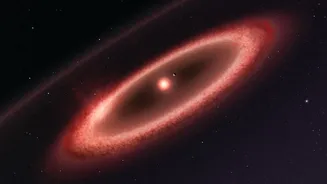
Imagine trying to watch a drama unfold behind a thick, smoky curtain. That’s the challenge astronomers face when studying star and planet formation. The birthplaces of planets, known as protoplanetary disks, are vast, swirling clouds of gas and dust surrounding
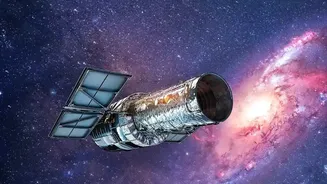
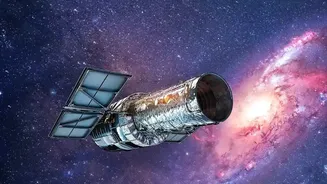
young stars. While this material is the very stuff from which planets are made, the tiny dust particles—more like smoke than household dust—are incredibly effective at blocking visible light. For telescopes like Hubble, which primarily see in visible and ultraviolet light, these dense regions appear dark and opaque, obscuring the crucial first steps of a planet's life. This cosmic dust has long kept the chaotic and beautiful process of planetary assembly hidden from our direct view.
Seeing the Universe in a New Light
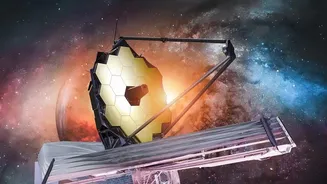
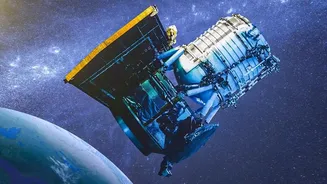
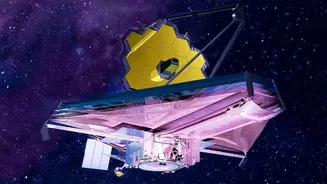
To see through this dust, you need a different kind of eye. The James Webb Space Telescope (JWST) was specifically designed to see the universe in infrared light. Infrared is a wavelength of light that is longer than what our eyes can detect, and we often perceive it as heat. Hotter, younger stars and forming planets glow brightly in infrared. Crucially, these longer light waves can pass more easily through the dense clouds of cosmic dust that would otherwise block them. By capturing this light, Webb effectively lifts the dusty veil, allowing scientists to peer into the heart of stellar nurseries and witness processes that were previously invisible. It’s like having thermal goggles that can see the heat signatures of nascent worlds through a cosmic smoke screen.
Webb's Superpowered Infrared Eyes
Webb's remarkable ability comes from a suite of highly advanced scientific instruments. The two primary tools for this task are the Near-Infrared Camera (NIRCam) and the Mid-Infrared Instrument (MIRI). NIRCam is sensitive to shorter infrared wavelengths, making it perfect for imaging the light from hot, young stars and the warmer gas closer to them. MIRI, on the other hand, detects longer, mid-infrared wavelengths. This allows it to see the faint glow from cooler dust particles further out in the disk and even the chemical makeup of the gas. By operating at extremely cold temperatures—MIRI is cooled to just 7 degrees above absolute zero—these instruments have unparalleled sensitivity, capable of picking up the faintest heat signals from billions of kilometres away.
Lifting the Veil on Stellar Nurseries
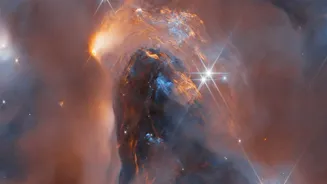
With these instruments, Webb is providing revolutionary views of protoplanetary disks. Where Hubble saw dark patches, Webb reveals intricate structures of gas and dust, including gaps and rings that signal the presence of newly forming planets carving out their orbits. Scientists have used Webb to observe the connection between water vapor in the inner parts of a disk and the inward drift of icy pebbles from the colder, outer regions—a key prediction of planet formation theories. The telescope’s spectrographs can even analyze the light passing through these disks to identify the chemical building blocks present, such as water, carbon dioxide, methane, and other complex organic molecules, offering clues about the potential composition of future planets and their atmospheres.
From Grains of Dust to New Worlds
Every image and data point from Webb helps refine our understanding of how planets, including our own, came to be. By studying a diverse range of protoplanetary disks, scientists can see the varied pathways planet formation can take. Some disks are rich in carbon, while others show abundant water and silicates, ingredients crucial for rocky, Earth-like planets. These observations are not just static pictures; they reveal dynamic processes, like stellar winds blowing gas away from the disk, which constrains the timeframe for planet formation. By piercing through the dust, Webb is moving beyond theories and gathering direct evidence of how chaotic clouds of gas and tiny specks of ice and rock assemble themselves into entire solar systems.