


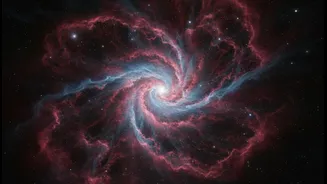


Galactic Archaeology in Centaurus A
To mark the fourth anniversary of its science operations, the James Webb Space Telescope (JWST) has delivered a transformative new view of Centaurus A, a peculiar galaxy located a relatively close 11 million light-years away. What makes this image so
revolutionary is Webb's powerful infrared vision, which slices through the thick dust lanes that have long obscured our view of the galaxy’s heart. Where other telescopes saw darkness, Webb reveals a densely packed tapestry of millions of individual stars. Scientists are calling it a form of 'galactic archaeology'. Each pinpoint of light is a star that can be studied to reconstruct the galaxy’s violent history, which includes a collision with another galaxy about two billion years ago. By studying the different generations of stars, astronomers can build a timeline of the galaxy's evolution, from its early formation to the bursts of star birth sparked by the ancient merger.
Cosmic Fireworks in a Stellar Nursery
Meanwhile, the venerable Hubble Space Telescope has captured what looks like cosmic fireworks, offering a front-row seat to a bustling star-forming region known as LH 95. Located in the Large Magellanic Cloud, a small satellite galaxy of our own Milky Way, this stellar nursery is ablaze with activity. The image is a spectacular clash of colours, with brilliant blue and white giant stars sparkling against glowing crimson clouds of hydrogen gas. These massive, hot blue stars are the engine of the region, blasting out intense ultraviolet radiation that heats the surrounding gas and sculpts it into ethereal shapes. But the image reveals more than just beauty; it provides new clues about the lifecycle of stars. Hubble’s sharp vision identified about 2,500 young, developing stars that are still pulling in gas and dust from their birth clouds, suggesting this crucial stage of stellar growth can last for millions of years.
A 60-Million-Star Portrait of Our Galaxy's Heart
The European Space Agency’s Euclid telescope, primarily designed to map the dark universe, has taken a stunning detour to capture the most detailed visible-light image ever of the Milky Way’s core. The result is a breathtaking vista packed with an estimated 60 million stars, looking into the dense, central bubble of our galaxy known as the galactic bulge. The image is so sharp it can separate individual stars in this incredibly crowded region, a feat that was previously impossible. This incredible clarity serves a dual purpose. Beyond its sheer beauty, the image acts as a crucial reference point for finding new worlds. It will help astronomers confirm the existence and measure the mass of exoplanets discovered through a technique called microlensing, which occurs when a nearby star acts as a cosmic magnifying glass for a more distant one.
Seeing the Universe in a Different Light
Proving that different telescopes tell different parts of the same cosmic story, NASA’s Chandra X-ray Observatory released a composite image of the galaxy cluster ZwCl 0024+1652, combining its X-ray data with visible light from Hubble. The release was part of a series celebrating the United States' 250th anniversary, rendering cosmic objects in patriotic red, white, and blue. In this image, the visible light from Hubble shows the galaxies themselves, while Chandra’s X-ray vision reveals something incredible: vast clouds of superheated gas surrounding the galaxies, shown in glowing red. This invisible gas contains more mass than all of the stars in all of the cluster's galaxies combined. By combining data from different wavelengths of light, astronomers can assemble a more complete picture of these colossal structures, studying everything from star formation to the pervasive influence of dark matter.