







The Official Rulebook
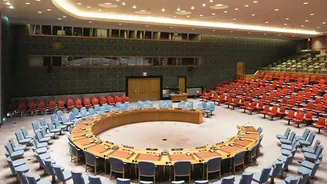
On paper, the process is straightforward. Article 97 of the UN Charter states that the Secretary-General “shall be appointed by the General Assembly upon the recommendation of the Security Council.” This means the 15-member Security Council first selects
a candidate, and then the 193-member General Assembly formally appoints them. While the General Assembly holds the power of appointment, it has never rejected a candidate recommended by the Council. The process typically concludes between October and December, with the new leader taking office on January 1 for what has become a customary five-year term.
The Security Council's Decisive Role
The real power lies with the Security Council, and more specifically, its five permanent members (P5): China, France, Russia, the United Kingdom, and the United States. Each of these five countries holds the power of veto. For a candidate to be recommended, they need to secure at least nine affirmative votes in the Council and, crucially, avoid a veto from any of the P5. A negative vote from a permanent member effectively ends a candidacy. This gives the P5 enormous influence, allowing them to block any candidate they find unacceptable, regardless of how much support that person has from other nations.
Secretive Straw Polls
To gauge support and identify potential vetoes, the Security Council conducts a series of informal secret ballots known as 'straw polls'. In these polls, members vote to 'encourage', 'discourage', or express 'no opinion' on each candidate. To reveal the intentions of the P5, later rounds often use colour-coded ballots: one colour for the permanent members and another for the 10 elected members. A 'discourage' vote on a coloured ballot signals a potential veto, letting candidates and their sponsors know where they stand without a formal veto ever being cast on the record.
The Unwritten Rules
Beyond the formal procedures, a set of powerful unwritten conventions shapes the selection. One of the most significant is the informal principle of regional rotation. The idea is that the top job should rotate among the UN's five regional groups, though this has not always been strictly followed. For the current selection to succeed António Guterres, whose term ends on December 31, 2026, there is a strong expectation that a candidate will come from the Latin American and Caribbean Group, a region that has not held the post since 1991. There's also a growing call for the UN to appoint its first-ever female Secretary-General. Another firm tradition is that nationals from any of the P5 countries are not considered for the role.
A Push for More Transparency
For decades, the selection process was almost entirely secret, often compared to a papal conclave. However, significant reforms initiated by the General Assembly in 2015 have introduced a new level of openness. For the first time, a formal call for candidates was issued via a joint letter from the presidents of the General Assembly and Security Council. Candidates now submit vision statements and participate in public, televised dialogues where they answer questions from member states and civil society. These changes were designed to make the process more inclusive and transparent, although the final decision-making power remains securely within the closed doors of the Security Council.