



The Universe's Runaway Growth Spurt
For nearly a century, we have known the universe is getting bigger. But in the late 1990s, astronomers made a shocking discovery: not only is it expanding, but the rate of expansion is speeding up. It was as if you threw a ball into the air and instead
of slowing down and falling, it shot upwards faster and faster. To account for this baffling cosmic acceleration, scientists proposed the existence of a mysterious, invisible force that makes up nearly 70% of the universe. They gave it a name as enigmatic as its nature: dark energy. Pinpointing what dark energy is and how it works remains one of the single biggest challenges in all of physics.
A New Cosmic Detective Arrives
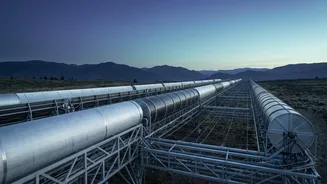
Enter the Canadian Hydrogen Intensity Mapping Experiment, or CHIME. Located in British Columbia, Canada, CHIME doesn't look like a traditional telescope. Instead of a giant dish, it consists of four massive, stationary half-pipe-shaped cylinders, each 100 metres long. With no moving parts, it uses the Earth's daily rotation to scan the entire northern sky. While CHIME has become famous for detecting hundreds of Fast Radio Bursts (FRBs), its primary mission was always cosmological: to create the largest-volume map of the universe ever made to better understand dark energy.
Listening for Ancient Hydrogen's Whisper
CHIME's method for probing dark energy is revolutionary. It doesn't look for individual stars or galaxies. Instead, it listens for the faint, collective radio glow of the most abundant element in the cosmos: neutral hydrogen. This hydrogen emits a signal at a specific wavelength of 21 centimetres. As the universe expands, waves of this ancient light get stretched on their journey to us. By measuring how much this light has stretched, CHIME can map the distribution of hydrogen gas billions of light-years away and, in turn, create a 3D map of the universe's structure at different points in its history. This technique, called hydrogen intensity mapping, is much faster and covers a vastly larger area than painstakingly counting individual galaxies.
A Major Milestone Achieved
In a recent breakthrough, the CHIME collaboration announced they have successfully detected the faint glow of hydrogen gas from when the universe was about 5 billion years old. Crucially, they achieved this using 'autocorrelation'—relying only on CHIME's own data without needing to cross-reference it with other galaxy surveys. This proves the hydrogen intensity mapping technique works and can be used as a standalone tool. While earlier work had hinted at this signal, this independent detection is a landmark moment, confirming CHIME can produce a reliable map of cosmic structure on its own. Researchers from India's Raman Research Institute also contributed to this important work.
What This Means for the Dark Energy Puzzle
This result does not yet solve the dark energy mystery, but it's a critical 'flag in the sand', as one scientist put it. It validates a powerful new method for measuring the universe's expansion history. By creating these vast cosmic maps, scientists can measure something called Baryon Acoustic Oscillations (BAOs)—giant, spherical patterns in the distribution of matter left over from the very early universe. These patterns have a known size, acting like a 'standard ruler'. By seeing how big this ruler appears at different distances, astronomers can precisely track how fast the universe was expanding at different times in its history. This data will provide a new, independent way to test competing theories about dark energy and could help resolve the 'Hubble tension'—a troubling disagreement between different methods of measuring the cosmic expansion rate.