





Cosmic Cannons of Creation
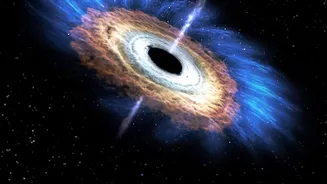
When a black hole feeds, not all the material from its companion star or surrounding gas clouds falls past the point of no return. A significant portion is channeled by intense magnetic fields and blasted away from the black hole's poles in two opposing
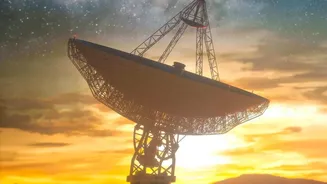
streams. These are known as relativistic jets, and they are among the most powerful phenomena in the cosmos, capable of shooting material across thousands of light-years and influencing the formation of entire galaxies. For years, astronomers have studied these jets to understand the physics of black holes, but their intricate movements have been difficult to pin down. A long-term vigil by space-based X-ray observatories like NASA's NuSTAR and ESA's INTEGRAL has been crucial, allowing scientists to move beyond single snapshots and watch these cosmic structures evolve in near real-time.
A Wobble in Spacetime
By combining years of high-energy X-ray and radio wave observations, scientists have made a stunning discovery: these powerful jets wobble. Researchers focusing on systems like MAXI J1820+070, a black hole about eight times the mass of our sun located 10,000 light-years away, observed a distinct precession, much like a spinning top wobbles as it rotates. This isn't a random flicker. The wobble is a direct consequence of a mind-bending prediction from Albert Einstein's theory of general relativity called the Lense-Thirring effect, or 'frame-dragging'. The theory posits that a massive, spinning object like a black hole doesn't just curve spacetime—it twists it, dragging the very fabric of the universe around with it.
The Ultimate Test of Relativity
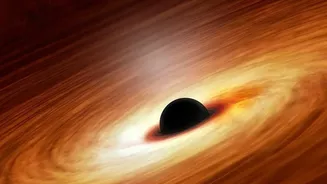
The cause of this jet precession is a misalignment between the black hole's spin axis and the plane of the accretion disk—the swirling plate of material it feeds on. The black hole’s 'frame-dragging' effect violently warps the inner part of this disk, tilting it. Since the jets are launched perpendicular to the inner disk, as the warped disk wobbles, so do the jets. Observing this effect in both X-rays (from the hot inner disk) and radio waves (from the jet itself) provides the first conclusive link between the two phenomena and offers one of the most compelling pieces of evidence for the Lense-Thirring effect to date. It's a powerful confirmation of Einstein's theories operating in one of the most extreme environments imaginable.
Rewriting the Black Hole Playbook
This discovery does more than just prove Einstein right yet again. It fundamentally changes our understanding of how black holes interact with their surroundings. The wobbling jets help explain the rapid and dramatic changes in brightness that astronomers have long observed from these systems. Furthermore, understanding this motion allows scientists to more accurately calculate the energy budget of a black hole—how much matter it consumes versus how much it blasts back into its host galaxy. This has profound implications, as these powerful, precessing jets can distribute energy and matter over vast regions of space, potentially disrupting or even triggering star formation in their host galaxies. The decade-long accumulation of X-ray data has provided a crucial key to unlocking how these cosmic engines truly work.