

A World of Water, Hidden in Plain Sight
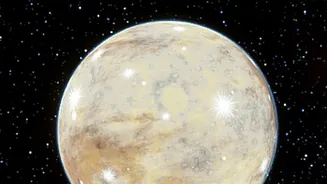
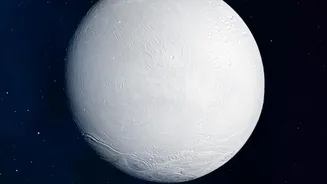
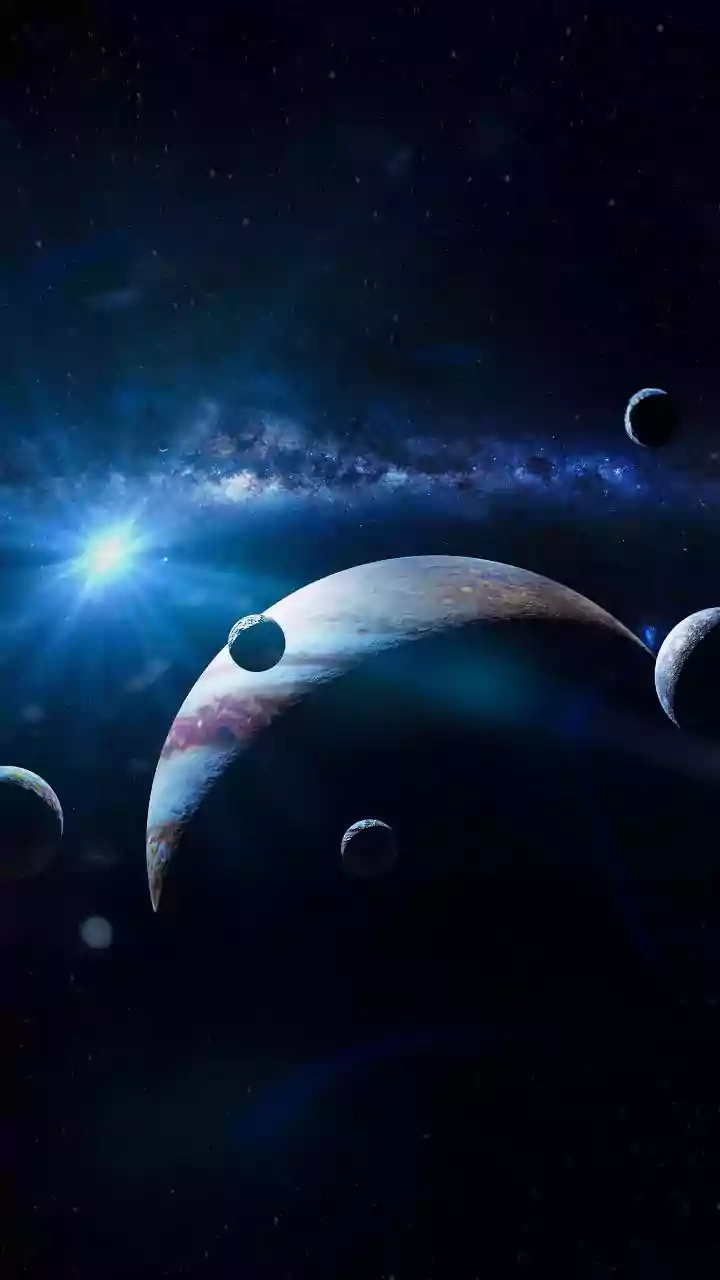
For decades, scientists have gathered compelling evidence that Jupiter’s moon Europa is hiding a global ocean of liquid saltwater beneath its frozen crust. This isn't a small sea; it’s an ocean thought to contain more than twice the amount of water as
all of Earth’s oceans combined. The first hints came from data collected by the Galileo spacecraft, which detected a disruption in Jupiter’s magnetic field around Europa. This suggested the presence of a deep layer of electrically conductive fluid, most likely a salty ocean. Further evidence comes from the moon’s strangely smooth and young surface, which is crisscrossed with cracks and streaks. This suggests the icy shell is not locked in place but floats on a liquid layer below, constantly shifting and resurfacing, erasing craters and other old features. The immense gravity of Jupiter creates tidal forces that flex and warm Europa's interior, keeping this massive ocean from freezing solid.
Meet the Clipper: Humanity’s Robotic Messenger
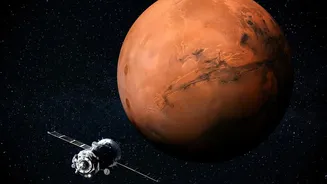
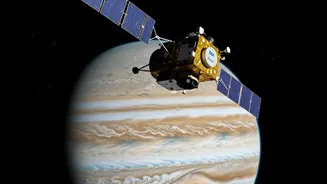
The Europa Clipper is the largest interplanetary spacecraft NASA has ever built, with solar arrays that span the length of a basketball court. Launched on October 14, 2024, it is now on a long journey to the outer solar system. Its 1.8-billion-mile trajectory isn't a straight shot. The spacecraft performed a gravity assist flyby of Mars in March 2025 and is scheduled for another with Earth in December 2026 to gain the speed needed to reach Jupiter. It is set to arrive in the Jovian system in April 2030. Instead of orbiting the radiation-blasted Europa directly, Clipper will enter a long, looping orbit around Jupiter. This path will allow it to perform dozens of close flybys of Europa, some as low as 16 miles (25 kilometers) above the surface. This clever strategy protects the spacecraft's sensitive electronics while allowing it to scan nearly the entire moon over its planned multi-year mission.
A Toolkit for Unlocking Secrets
To peer beneath the ice, Europa Clipper is outfitted with a powerful suite of nine science instruments. An ice-penetrating radar, called REASON, is designed to measure the thickness of the moon’s icy shell and search for pockets of water within it. A magnetometer will take precise measurements of the magnetic field to confirm the ocean's existence and even estimate its depth and salinity. High-resolution cameras, part of the EIS instrument, will map the fractured surface in stunning detail, helping scientists understand the geologic activity. Spectrometers like MISE and Europa-UVS will analyze the surface composition, looking for salts and organic compounds that might have bubbled up from the ocean below. Other instruments will sample any particles in Europa’s thin atmosphere, hoping to catch material vented from the ocean in potential plumes of water vapor.
The Ultimate Goal: Assessing Habitability
While Europa Clipper is not a life-detection mission, its primary goal is to determine if Europa has the necessary ingredients for life as we know it: liquid water, essential chemical elements, and a source of energy. The mission will create a detailed portrait of this ocean world, characterising its ice shell, ocean, composition, and geology. By confirming the ocean's existence, measuring its properties, and hunting for organic molecules, Clipper will provide the most comprehensive assessment yet of Europa’s potential habitability. It will help scientists understand if there are places beneath the ice that could support life right now. Finding environments with the right conditions would be a monumental discovery in its own right, paving the way for future missions that might one day search for life directly.