






If you've ever lamented the blandness of an in-flight meal, you're not alone. For decades, the culprits were thought to be low cabin pressure and dry air. But science now points to a more pervasive factor: the engine's constant roar.
More Than Just Altitude and Dry Air
For years, the common
wisdom was that airline food tasted different primarily because of the cabin environment. At cruising altitude, cabin pressure is equivalent to being 6,000 to 8,000 feet up a mountain. This, combined with humidity levels below 12%, dries out our nasal passages. Since about 80% of what we perceive as taste is actually smell, this has a significant dulling effect. Studies have shown this environment can reduce our sensitivity to sweet and salty tastes by up to 30%. While these factors are certainly part of the equation, they don’t tell the whole story. A growing body of research reveals that the non-stop, loud noise of the aircraft cabin plays a surprisingly critical and specific role in altering our perception of flavour.
The Sound of a Dulled Palate
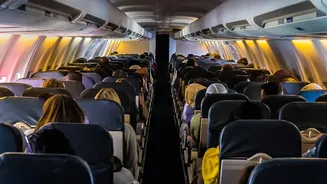
An airplane cabin at cruising altitude is a noisy place, with engine and airflow sounds often reaching 85 decibels or more. This constant drone isn't just background noise your brain can easily ignore; it actively interferes with your ability to taste. This phenomenon is part of a field called cross-modal perception, where one sense (hearing) affects another (taste). Your brain has a finite amount of sensory bandwidth. When it's busy processing the loud, persistent hum of the jet engines, it has fewer resources to dedicate to the signals coming from your taste buds. Think of it like trying to have a quiet conversation at a loud concert—the main event simply drowns out the subtleties. This sensory distraction is the key to why your meal tastes so different in the air.
How Noise Hijacks Sweet and Salty Flavours
The effect of noise on taste isn't uniform. Landmark studies, including one from Cornell University, have shown that loud background noise specifically suppresses our ability to perceive sweetness and, to some extent, saltiness. In experiments, participants tasting sweet solutions in a simulated noisy cabin environment rated them as significantly less sweet than when they tasted them in silence. The theory is that the nerve responsible for carrying taste signals, the chorda tympani, passes through the middle ear. The constant stimulation from loud noise may interfere with this nerve's ability to transmit taste signals accurately, particularly for sweet flavours. So, that dessert you were looking forward to might genuinely taste less satisfying at 35,000 feet, not because the recipe is bad, but because your brain is too distracted by the noise to fully appreciate it.
The Surprising Power of Umami
While noise dulls our perception of sweetness, it has the opposite effect on another of the five basic tastes: umami. Umami is the savoury, brothy, and rich flavour found in foods like tomatoes, mushrooms, parmesan cheese, and soy sauce. The same studies that found sweetness was suppressed discovered that umami was actually enhanced by loud cabin noise. This explains a long-observed travel phenomenon: the popularity of tomato juice on flights. Many people who would never drink it on the ground find it deeply satisfying in the air. Lufthansa reported that it serves almost as much tomato juice as it does beer. The high concentration of natural umami compounds in tomatoes makes them taste more robust and flavourful in a noisy environment, cutting through the sensory fog created by the engines.
Airlines Take a Scientific Approach
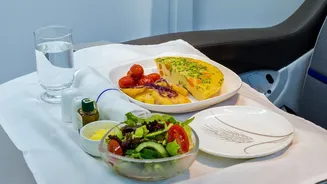
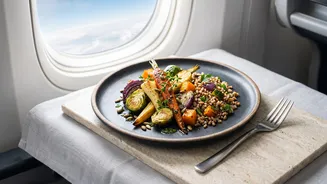
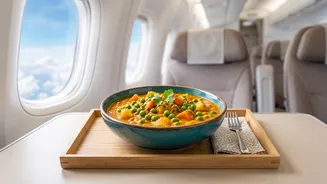
This growing understanding of 'sonic seasoning' has not been lost on the airline industry. In -flight caterers and chefs now intentionally design menus that work with, rather than against, the challenging cabin environment. To combat the dulling effect, meals are often more heavily seasoned than they would be on the ground. More importantly, airlines are increasingly leaning into umami -rich ingredients. You'll find dishes featuring tomato -based sauces, mushroom gravies, aged cheeses, and curries, as these flavours are not only stable but often perceived as more intense at altitude. Airlines like Singapore Airlines and others even test their recipes in pressurized chambers that simulate the exact conditions of a flight, ensuring the meals taste as good as possible when they finally reach your tray table.