




Seeing the Invisible Universe
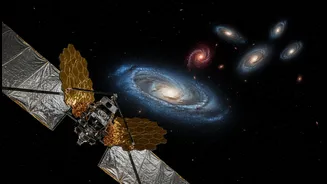
When we look at a vibrant image from the James Webb Space Telescope (JWST), we aren't seeing what our eyes would. The telescope is a master of the infrared spectrum, observing light waves that are too long for the human eye to detect. This is its superpower.
Infrared light can pierce through the thick cosmic dust clouds that obscure the view of telescopes like Hubble, which primarily sees visible light. This allows Webb to gaze into stellar nurseries where new stars are born and peer back in time to the very first galaxies. The raw data Webb sends back to Earth, however, isn't a beautiful picture; it's a series of black-and-white frames, each representing the intensity of infrared light captured by its advanced detectors. The breathtaking colours come later, in a process that is both a science and an art.
From Data to Digital Masterpiece
Turning Webb's data into the masterpieces we see is a meticulous process handled by science visuals developers. They take the data from different infrared filters and assign visible colours to them. Typically, the longest infrared wavelengths are assigned red, and the shortest are assigned blue, with green and other colours in between. This chromatic ordering helps scientists interpret the data, as the colours highlight different chemical elements, temperatures, and structures that would otherwise be imperceptible. It’s less about showing what something ‘truly’ looks like and more about creating a scientifically accurate representation of phenomena our eyes can’t see. The goal is to make the scientific information digestible and engaging, effectively translating complex physics into a universally understood visual language.
Revisiting a Cosmic Icon: The Pillars of Creation
One of the most dramatic examples of Webb’s power is its view of the “Pillars of Creation,” a star-forming region in the Eagle Nebula first made famous by Hubble in 1995. In Hubble’s visible-light image, the pillars appear as dark, dense, and somewhat opaque columns of gas and dust. Webb’s near-infrared image transforms the scene. The pillars become semi-transparent and rust-coloured, allowing us to see through the gas and dust. Thousands of newly formed stars, previously hidden, sparkle into view as bright red orbs. This new perspective isn't just prettier; it provides crucial information about the star-formation process, showing us the young stars as they burst free from their dusty cocoons. It’s a direct look into the lifecycle of stars, made possible only by seeing in infrared.
The Cosmic Cliffs: A Glimpse of Star Birth
Another of Webb’s landmark images shows what has been nicknamed the “Cosmic Cliffs” of the Carina Nebula. Looking like a mountain range on a moonlit night, the image is actually the edge of a giant, gaseous cavity carved out by intense radiation from massive young stars. The image combines data from two of Webb's instruments, revealing hundreds of previously hidden stars and jets of material being shot out by stars as they form. What appears as “steam” rising from the cliffs is hot, ionized gas streaming away from the nebula wall. This view provides an unprecedented look at a period of very early star formation, an event that is difficult to capture because it is so brief in cosmic terms. Webb’s sensitivity allows astronomers to chronicle these fleeting, powerful moments in stunning detail.
A Window to the Dawn of Time
Beyond creating beautiful portraits of nebulae, Webb’s primary mission is to look deep into the universe's past. Because light takes time to travel, looking at distant objects is equivalent to looking back in time. Webb has already identified galaxies that existed just a few hundred million years after the Big Bang—far earlier and more developed than many theories predicted. These ancient galaxies have challenged and refined our models of the early universe. Recent findings from July 2026 even show Webb mapping the cosmic web, the large-scale structure of the universe, in unprecedented detail, revealing how galaxies evolved over 13 billion years. It is also providing new insights into how the first supermassive black holes formed.