
A Glimpse into a Star's Ghost
First, let’s set the scene. The Helix Nebula is what’s known as a planetary nebula, located about 650 light-years away in the constellation Aquarius. The name is a bit of a misnomer; it has nothing to do with planets. Instead, it’s the beautiful remnant
of a dying star, one that was once much like our own Sun. In its final phases, the star shed its outer layers of gas, which expanded into space. The star’s hot, dense core, now a white dwarf, unleashes intense ultraviolet radiation that causes this expelled gas to glow, creating the intricate structure we see. Think of it as a star’s final, glorious sigh before it fades.
Enter the 'Cometary Knots'
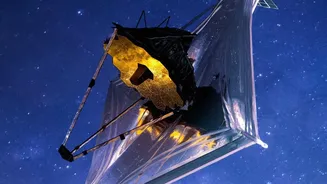
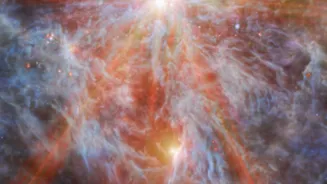
Zooming in on this celestial artwork, first with the Hubble Space Telescope and more recently with the James Webb Space Telescope, reveals something astonishing: thousands upon thousands of small, dense globules fringing the nebula’s inner ring. There are an estimated 40,000 of them in the Helix Nebula alone. They're called 'cometary knots' because they look like comets, with a bright, compact head and a long, faint tail streaming away. But don't let their appearance fool you. These are not solid, icy bodies like the comets in our solar system. They are gigantic structures of gas and dust. Each knot's head is roughly twice the size of our entire solar system, and their tails can stretch for 100 billion miles.
Why They Look Like Comets
The comet-like shape is a result of the harsh environment inside the nebula. The knots are extremely dense—at least a thousand times denser than the surrounding gas. As the central star's fierce radiation and powerful stellar winds blow outward, they slam into these dense clumps. The side of the knot facing the star lights up, forming the bright 'head.' The rest of the material is shielded behind this dense core and gets sculpted into a long tail pointing directly away from the star, much like a windsock in a gale. So, while they aren't actually comets, their shape is a direct consequence of the same basic principle: a central force acting on a smaller object.
The Core of the Mystery
Here's what makes these knots so scientifically intriguing: their very existence is a puzzle. The origin of these dense clumps is still a subject of active research. Did they form when the star was in its earlier, giant phase and somehow survive the violent transition into a planetary nebula? Or did they form afterward, condensing out of the cooling, expanding gas like raindrops from a cloud? One leading hypothesis is that they are the result of a collision between hot, fast-moving gas blasted from the star and cooler, slower gas that was ejected thousands of years earlier. This cosmic crash could have fragmented a smoother cloud into the dense, tadpole-shaped droplets we observe today. In essence, they are survivors, resilient clumps that withstood a stellar apocalypse.
A Laboratory for Cosmic Chemistry
Beyond their mysterious origins, the knots serve as invaluable cosmic laboratories. They are packed with molecular hydrogen and dust, which are typically destroyed by the intense ultraviolet radiation that permeates a planetary nebula. The dense heads of the knots act as protective shields, allowing these molecules to survive inside. This makes them crucial for understanding how complex molecules behave and evolve in extreme radiation environments. Studying them provides clues about how dying stars enrich the interstellar medium with heavier elements and molecular material—the very stuff that will one day form new stars and planets. Images from the James Webb Space Telescope are providing an unprecedentedly clear view, helping scientists map the transition from hot, ionized gas to the cooler, molecule-rich regions within these knots.