






The Most Important Debriefing
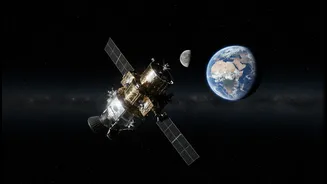
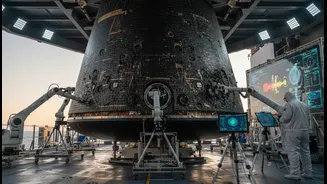
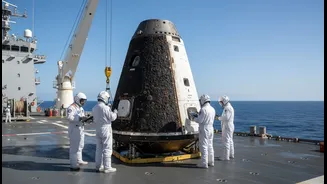
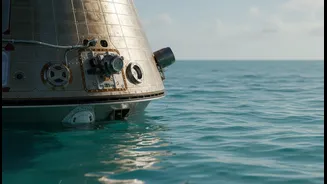
After splashing down in the Pacific Ocean in April 2026, the Orion spacecraft was carefully recovered and transported back to NASA's Kennedy Space Center. This homecoming marked the beginning of an exhaustive, piece-by-piece inspection. Teams are poring
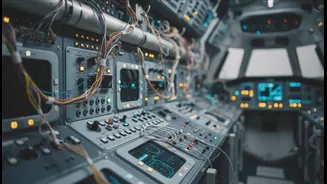
over every component, from the life support systems that kept the four astronauts safe to the avionics that guided their nearly 700,000-mile journey. This process is less about celebrating success and more about learning. Every scratch, every data point, and every system performance report is evidence that will directly inform the design and construction of the spacecraft for Artemis III and beyond, ultimately determining what NASA keeps, what it improves, and what it completely rethinks for humanity's return to the lunar surface.
The Heat Shield Passes Its Fiery Test
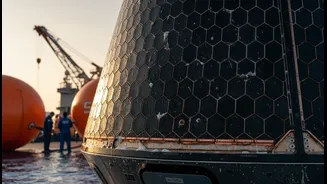
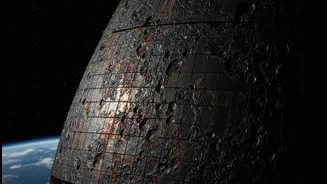
A primary focus of the post-flight analysis is Orion’s heat shield. After the uncrewed Artemis I mission showed unexpected charring and erosion of the shield's material, all eyes were on how it would perform on a crewed flight. Initial inspections after the April 10 splashdown revealed excellent news: the char loss was significantly reduced compared to the first flight, and the system performed as predicted by revised models. Engineers conducted extensive ground testing after Artemis I to understand the issue, and the success of the Artemis II shield validates their fixes. This is a massive win, confirming that the fundamental design is sound. The decision is to keep the current AVCOAT material and manufacturing process, giving NASA confidence that it can safely protect astronauts returning from the Moon at speeds of nearly 25,000 mph.
Keeping the Crew Safe and Comfortable
The Artemis II mission was the first real-world test of Orion’s Environmental Control and Life Support System (ECLSS) with humans on board for a 10-day deep space mission. The system is responsible for providing breathable air, managing cabin temperature and pressure, and handling waste. While the flight was overwhelmingly successful, post-flight checks are crucial for refining these systems for longer-duration stays on the Moon. Astronauts participated in numerous studies to see how the deep space environment affected their bodies, providing vital data on everything from radiation exposure to sleep patterns. While minor issues like a small helium leak in the propulsion system and a toilet malfunction were reported, these are seen as valuable learning opportunities. Engineers now have concrete data to make these systems more robust and reliable for the much more demanding missions to come.
Upgrading the Brains and Senses
Beyond the physical hardware, the performance of Orion's software, navigation, and communication systems is under the microscope. The mission successfully tested a manual piloting demonstration, where the crew took control to maneuver the spacecraft, providing key data for future rendezvous and docking operations. The astronauts also acted as scientists, using their own eyes to observe lunar features, noting subtle color variations and even witnessing meteoroid impacts—observations that robotic orbiters might miss. These human insights are invaluable. Reusable components like flight computers and navigation units will be removed, thoroughly tested, and potentially refurbished for future flights. The evidence gathered confirms the core software and guidance systems are effective, but will lead to refinements that enhance astronaut control and scientific observation capabilities for Artemis III, which is set to test docking capabilities in Earth orbit.