





When we think of India’s great mountains, the colossal, snow-capped Himalayas often come to mind first. But what if the quiet, rolling hills of the Western Ghats hold a story that is far older and just as profound? It's a tale of two mountains.
A Tale of Two Origins
In the
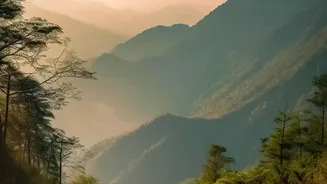
grand story of Earth's geology, mountains are born from immense power. The Himalayas and the Western Ghats, two of India’s most iconic ranges, are perfect examples, yet they were formed in entirely different ways. The Himalayas are the product of a monumental collision, while the Western Ghats are a legacy of a great continental breakup. This fundamental difference in their origins is the key to understanding why the Ghats are ancient relics, while the Himalayas are geological newcomers. The Himalayas, soaring to heights of over 8,000 meters, are 'fold mountains'. They were born when the Indian tectonic plate, after drifting north for millions of years, crashed into the Eurasian plate. In contrast, the Western Ghats are not the result of a collision. They are 'fault-block' mountains, which are essentially the uplifted and eroded edge of the Deccan Plateau. Their story begins not with a crash, but with the slow tearing apart of a supercontinent.
The Ancient Legacy of Gondwana
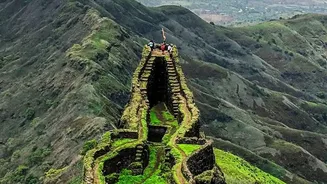
To find the origin of the Western Ghats, we must travel back about 150 million years. At this time, much of the world's landmass was fused into a single supercontinent called Gondwana, which included modern-day South America, Africa, Antarctica, Australia, and India. As this supercontinent began to break apart, the landmass that would become India rifted away from Africa and Madagascar. This separation created a dramatic, cliff-like edge along the western coast of the newly formed Indian landmass. This fractured edge, uplifted and then shaped by millions of years of erosion, became the Western Ghats. So, while the peaks themselves have been weathered down, the underlying rock formations are incredibly old, with some parts dating back over 200 million years, a direct inheritance from their time as part of Gondwana. The formation of the Deccan Traps, a massive volcanic province, around 66 million years ago, further shaped the northern parts of the range.
The Young and Restless Himalayas
The story of the Himalayas begins much more recently, around 40 to 50 million years ago. After breaking from Gondwana, the Indian plate drifted northward across the ancient Tethys Ocean at a remarkable speed. When it finally collided with the much larger Eurasian plate, the impact was so powerful that neither landmass could slide under the other. Instead, the crust buckled, folded, and was thrust skyward, creating the towering peaks we see today. This process is far from over. The Indian plate continues to push into Eurasia at a rate of a few centimetres per year, which means the Himalayas are still growing, rising by several millimetres annually. This ongoing collision also makes the region one of the most seismically active in the world. In geological terms, the Himalayas are boisterous teenagers—tall, still growing, and prone to sudden movements.
An Epic Tale Told by Biodiversity
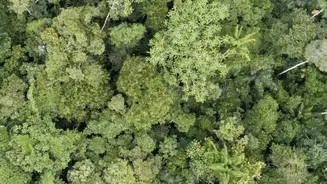
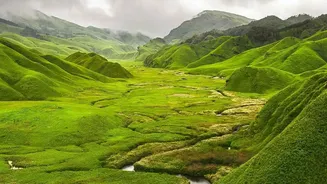
This vast difference in age and geological stability has had a profound impact on the biodiversity of each mountain range. The Western Ghats, having been a stable landform for over 100 million years, have acted as a cradle for evolution. This long period of uninterrupted evolution has allowed for the development of an incredible number of endemic species—plants and animals found nowhere else on Earth. UNESCO recognises the range as one of the world's eight 'hottest hotspots' of biological diversity, home to at least 325 globally threatened species. The high montane forests and shola grasslands have nurtured unique lifeforms for eons. The Himalayas, while also a biodiversity hotspot, tell a different story. Their extreme altitude, geologically recent uplift, and harsh, glaciated conditions create different ecological niches. The flora and fauna here are adapted to high altitudes and cold, with species like the snow leopard and red panda making their home in its rugged terrain.