



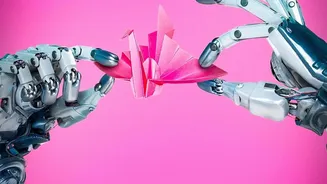


From Coder to Orchestrator
The fundamental shift driven by AI is from doing to directing. While headlines often focus on AI replacing jobs, the reality is more nuanced; AI is reshaping them. Routine coding, bug fixing, and software testing are increasingly being automated by AI tools,
with some assistants boosting developer productivity by up to 55%. This doesn't make developers obsolete. Instead, it elevates their role. The future belongs to professionals who can design complex systems, define problems for AI to solve, and integrate AI-powered components into larger applications. The focus is shifting from writing every line of code to orchestrating a symphony of AI agents and human ingenuity. It’s less about being a builder and more about being an architect.
Essential Technical Skills for 2026
To stay ahead, a new set of technical skills has become non-negotiable. While a foundation in programming languages like Python remains crucial, the real value now lies in AI-specific competencies. Professionals should focus on mastering machine learning concepts, natural language processing (NLP), and the architecture of generative AI models. A critical, in-demand skill is prompt engineering—the art of communicating effectively with AI to get desired outcomes. Furthermore, as companies move from AI experimentation to deployment, MLOps (Machine Learning Operations) is vital for managing, monitoring, and maintaining AI models in production environments. Experience with cloud platforms and vector databases is also becoming a key differentiator in the job market.
The Irreplaceable Value of Human Skills
As AI handles more repetitive technical tasks, uniquely human skills have become more valuable than ever. Industry body NASSCOM has warned against creating a workforce that is merely 'AI-reliant' rather than 'AI-native,' stressing the importance of deep engineering expertise and independent judgment. The World Economic Forum predicts that 44% of a worker's core skills will be disrupted in the next five years, highlighting the need for continuous learning. Skills like critical thinking, creative problem-solving, and strategic decision-making are where humans excel. AI can generate options, but it takes a human to understand the business context, navigate complex stakeholder needs, and make the final, nuanced call. Communication and collaboration are also becoming premium skills as development becomes a partnership between human experts and AI tools.
Understanding AI Ethics and Governance
As AI systems become more integrated into business and society, understanding their ethical implications is no longer a niche concern. Professionals, especially those in senior roles, must be well-versed in the principles of responsible and ethical AI. This includes ensuring that AI models are fair, transparent, and free from bias. As India's digital economy grows, regulatory frameworks around AI are expected to tighten. Professionals who can navigate these complexities, audit AI systems for fairness, and build trustworthy technology will be in high demand. This skill set moves an IT professional from a purely technical role to that of a trusted advisor and strategic leader.
New Roles and Opportunities Emerge
The narrative of AI causing mass job losses is being challenged by data showing significant job creation. A recent Nomura report found that AI has created more jobs than it has eliminated in India, with over 83,000 AI-linked hires against roughly 32,000 losses. While entry-level hiring for routine tasks has declined, new, specialized roles are emerging. These include AI Software Engineer, AI Product Manager, AI Ethics Specialist, and MLOps Engineer. Reports suggest AI could add up to $500 billion to India's GDP by 2030, creating millions of new technology jobs in the process. The key is to pivot from roles that are easily automated to those that require this new blend of technical and strategic AI expertise.