





A New Kind of Atmospheric Brake
For decades, space agencies have relied on rigid, often single-use heat shields to protect returning capsules. These ablative shields, like those on the Apollo missions, essentially burn away layer by layer to dissipate the extreme heat of re-entry. While
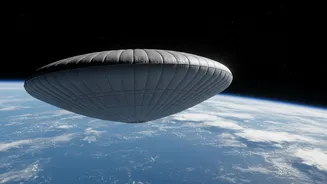
effective, they have a fundamental limitation: their size is constrained by the rocket's payload fairing, the nose cone that protects cargo during launch. This size limit directly restricts the mass of the payload that can be safely landed. An inflatable heat shield, officially known as a Hypersonic Inflatable Aerodynamic Decelerator (HIAD), shatters this limitation. It launches in a tightly packed configuration and inflates in space just before entering the atmosphere, creating a much larger surface area than a rigid shield ever could.
How Inflatables Survive the Inferno
The idea of an inflatable object surviving temperatures that can reach thousands of degrees seems counterintuitive. The system consists of two main parts: a tough, inflatable structure and a flexible thermal protection system. The inflatable part is made of stacked rings, or tori, woven from advanced synthetic polymers that are incredibly strong and temperature-resistant. These rings form the shield's shape and provide structural rigidity once inflated. Over this structure lies a high-tech thermal blanket. This outer layer is made of advanced ceramic fiber composites and other materials designed to withstand the brutal heat and aerodynamic forces of re-entry. It functions like a traditional shield, absorbing and radiating away heat, while the inflatable structure behind it maintains the vehicle's shape and stability.
The Efficiency of Being Big
The key to the HIAD's efficiency lies in its size. A larger diameter heat shield is far more effective at slowing a spacecraft down. It acts like a giant atmospheric brake, creating more drag to decelerate the vehicle higher in the atmosphere where the air is thinner and heating is less intense. This reduces the peak temperatures and forces experienced by the spacecraft. Because they are lightweight and can be packed into a small volume, inflatable shields offer a huge advantage in mass and space, the two most precious commodities in rocket science. NASA's successful LOFTID (Low-Earth Orbit Flight Test of an Inflatable Decelerator) mission in 2022 was a landmark demonstration. The 6-meter diameter shield successfully endured re-entry from orbital velocity, proving the technology's viability for a wide range of demanding missions.
Unlocking the Future of Exploration
The implications of this technology are immense. Inflatable heat shields are seen as a critical enabling technology for future ambitious space missions. For Mars, which has a very thin atmosphere, a large, lightweight decelerator is essential for landing heavier payloads, such as the habitats and equipment needed for human missions. It would also allow access to higher-altitude landing sites that are currently unreachable. The technology isn't just for Mars; it could be used for missions to Venus, Saturn's moon Titan, or any celestial body with an atmosphere. Closer to home, HIADs could enable the cost-effective return of large cargo from low-Earth orbit, including manufactured goods from space stations or even reusable rocket stages, a goal being pursued by companies like United Launch Alliance.