






An Accidental Discovery
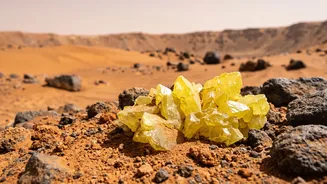
In 2024, the Curiosity rover was traversing the Gediz Vallis region within Mars's vast Gale Crater when it made a serendipitous discovery. As the rover's wheels rolled over an unassuming rock, it cracked open, revealing a bright, pale yellow interior.
Analysis by the rover's instruments confirmed this was pure, elemental sulfur—the first time it had ever been found in this form on Mars. While the planet is known to be rich in sulfates, which are sulfur-containing salts left behind by evaporated water, finding pure sulfur was a geological surprise. On Earth, such a find often points to specific, high-energy environments. This unexpected patch of yellow on the Red Planet presented scientists with a brand new mystery.
Why Sulphur is a Signpost
The excitement surrounding any sulfur-related discovery on Mars is rooted in its fundamental role in biology. On Earth, sulfur is an essential element for all known life, a key component in two of the amino acids used to build proteins. Many terrestrial microbes use sulfur compounds as a source of energy. Because of this deep connection, scientists use the sulfur cycle—how the element moves through the environment and in what forms—as a potential tool to search for biosignatures, the tell-tale signs of past or present life. Finding a large, unexpected deposit of pure sulfur naturally led to the question: could this be a trace of ancient Martian biology at work?
A Puzzle Without a Volcano
Initially, scientists looked to Earth for analogues. Here, large deposits of elemental sulfur are typically created by intense volcanic or hydrothermal activity, where hot, sulfur-rich gases and fluids emerge from underground. However, the area around Gediz Vallis showed no obvious signs of the high-temperature conditions needed to produce the sulfur field in this way. The rocks themselves were also surprisingly fragile, suggesting they likely formed in the exact spot they were found, as they would not have survived being transported by ancient floods or landslides. This ruled out many simple geological explanations and forced researchers to explore more complex, and uniquely Martian, possibilities.
Chemistry, Not Biology
As the headline suggests, the latest research strongly indicates that life is not needed to explain the Martian sulfur. Two studies published in 2026 provided compelling, non-biological pathways. One theory proposes that ancient volcanic gases were trapped beneath the surface, possibly in ice structures. As erosion later carved out the valley, these gases were released and, through a series of chemical reactions, formed pure sulfur without requiring high heat at the deposit site. A second study demonstrated in a laboratory that pure sulfur crystals could form at room temperature. The experiment mixed dissolved sulfide with chlorate—a chemical thought to have existed on ancient Mars—in acidic water, successfully producing elemental sulfur. This proves that purely inorganic chemistry could have created the deposit.
A New Chapter in Mars' Story
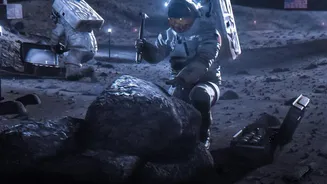
While the finding does not point to life, it provides an invaluable window into Mars's deep past. The sulfur deposit acts as a time capsule, offering clues about the planet's environment roughly 3 billion years ago. It suggests the Martian sulfur cycle was far more diverse than previously known, involving complex interactions between the atmosphere, water, and subsurface geology. Understanding how these fragile deposits formed and survived helps scientists model how the Martian climate evolved from a potentially wetter world to the dry planet we see today. On a more futuristic note, the discovery is also promising for potential human exploration. Pure sulfur is a key ingredient needed to manufacture strong Martian concrete, meaning future astronauts may have access to a crucial building material right on site.