


The Birth of a Star: A Slow Beginning
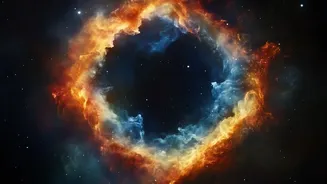
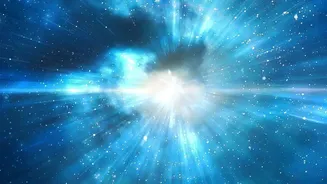
A new star begins its life not with a bang, but with a slow gathering. It all starts inside vast, cold clouds of gas and dust known as molecular clouds or stellar nurseries. Within these clouds, gravity pulls pockets of matter together into dense clumps.
As a clump contracts, its core heats up, forming what is called a protostar—a baby star. For millions of years, this protostar continues to draw in material from its surroundings. The immense pressure and temperature at its center eventually ignite nuclear fusion, the process where hydrogen atoms are fused into helium, releasing tremendous energy. This energy pushes outward, creating a balance with gravity's inward pull, and a stable, shining star is born.
The Supernova: An Explosive Death
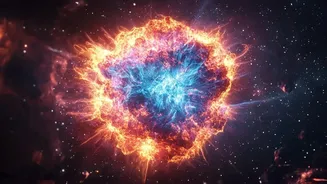
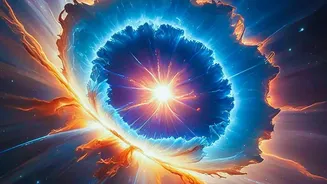
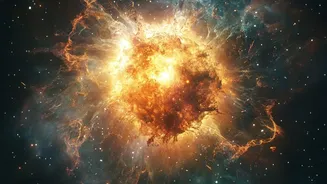
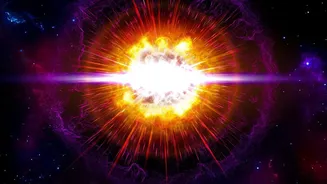
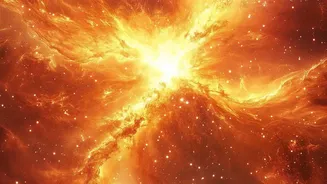
A supernova, in stark contrast, is the cataclysmic explosion marking the end of a star's life. This spectacular event can happen in two primary ways. The first, a core-collapse supernova, occurs when a massive star—at least eight to ten times the mass of our sun—runs out of nuclear fuel. Without the outward pressure from fusion to counteract gravity, the star's core collapses in seconds, triggering a massive shockwave that blows the star apart. The second type, a Type Ia supernova, happens in a binary star system where a dense stellar remnant called a white dwarf siphons material from a companion star. Once the white dwarf accumulates too much mass, it triggers a runaway thermonuclear explosion that completely destroys it.
Creation vs. Destruction: The Core Differences
The most fundamental difference is simple: a new star is an act of creation, while a supernova is an act of destruction. Star formation is a process of accumulation, where gravity slowly builds something new over millions of years. A supernova is an instantaneous, violent release of energy from a dying star, an explosion so powerful it can briefly outshine its entire galaxy. While star birth uses hydrogen as its primary building block, supernovae are responsible for creating and scattering heavier elements—from oxygen to iron and beyond—across the cosmos. These elements enrich interstellar space, providing the raw materials for the next generation of stars and planets.
Kepler's Supernova of 1604: A Star in the History Books
In October 1604, observers across Europe and Asia witnessed what appeared to be a 'new star' suddenly appear in the constellation Ophiuchus. At its peak, it was brighter than any star in the night sky and was even visible during the day for over three weeks. The event was documented in detail by German astronomer Johannes Kepler, whose comprehensive study led to it being named Kepler's Supernova, or SN 1604. Little did he know, he wasn't witnessing the birth of a star, but its dramatic death. This was the last supernova to be definitively observed with the naked eye within our own Milky Way galaxy.
What We Learned From Kepler's Star
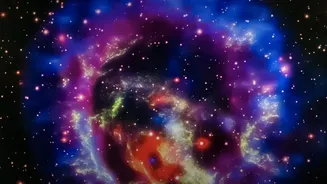
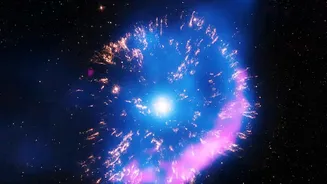
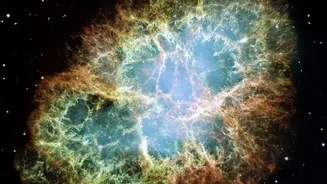
Kepler's Supernova was a pivotal event in the history of astronomy. Along with another supernova observed in 1572, it challenged the long-held belief that the heavens were perfect and unchanging. Today, modern telescopes like NASA's Chandra X-ray Observatory have studied the expanding cloud of gas and dust left behind, known as a supernova remnant. These observations have confirmed that SN 1604 was a Type Ia supernova, resulting from an exploding white dwarf in a binary system. By studying the remnant, astronomers can learn more about the mechanics of these explosions, which are used as 'cosmic distance markers' to measure the expansion of the universe.