




The Invisible Threat From Our Sun
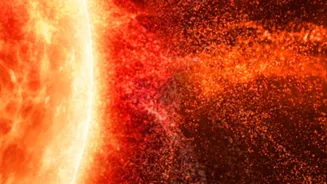
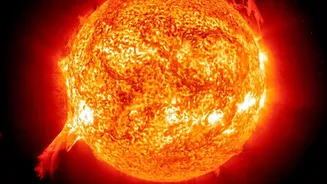
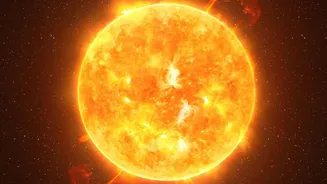
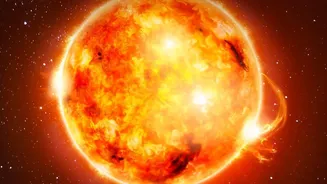
The sun, our life-giving star, has a turbulent side. It constantly releases a stream of charged particles known as the solar wind. Occasionally, it erupts with much greater force, unleashing solar flares—intense bursts of radiation—and coronal mass ejections
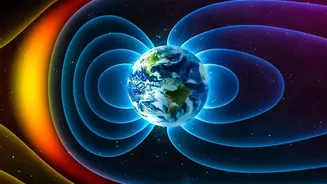
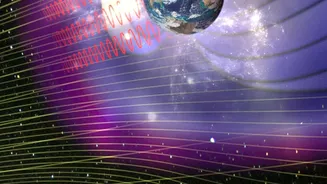
(CMEs), which are massive clouds of plasma and magnetic fields hurtling through space. When this 'space weather' is directed at Earth, it can have significant consequences. These events can trigger powerful geomagnetic storms in our planet's magnetic environment. While these storms are famous for creating beautiful auroras, they also pose a serious risk to our technology-dependent society. A historic event in 1859, the Carrington Event, caused fires in telegraph stations; a similar storm today could cripple economies by causing widespread blackouts and disrupting global communications.
Why Satellites Are So Vulnerable
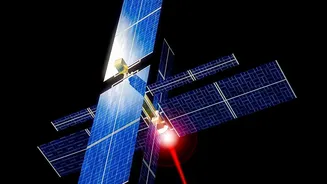
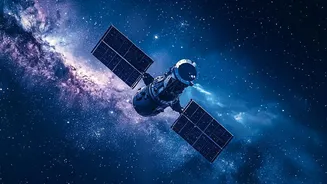
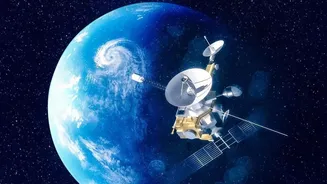
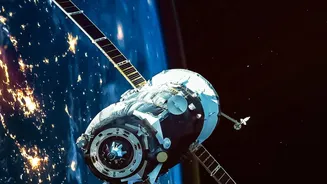
Satellites orbiting Earth are on the front lines of this solar onslaught. With over 2,000 active satellites and tens of thousands more planned, the risk is growing. There are several ways space weather can harm them. Firstly, the radiation from flares heats and expands Earth's outer atmosphere. This increases the atmospheric drag on satellites in low-Earth orbit, causing them to lose altitude faster than planned and shortening their operational lifespan. In a stark example, a geomagnetic storm in 2022 was blamed for the loss of up to 40 newly launched Starlink satellites. Secondly, high-energy particles can penetrate satellite shielding and build up a charge within the electronics, leading to a discharge that can damage or destroy critical components. This phenomenon, known as internal charging, has been linked to numerous satellite malfunctions. Finally, these solar events can directly interfere with the communication signals that satellites transmit, disrupting everything from GPS navigation to television broadcasts.
The Challenge of Predicting a Storm in Space
For decades, predicting space weather has been a significant challenge. Unlike weather on Earth, solar storms develop with incredible speed, and older forecasting models often gave warnings of only a few hours, if that. Part of the problem was the complexity of the sun's magnetic activity. Furthermore, recent analysis suggests that the impact of extreme solar storms could be roughly twice as large as previously estimated, highlighting the limitations of past models. This makes the need for faster, more accurate warnings more urgent than ever, especially as the sun approaches its next 'solar maximum'—the peak of its 11-year activity cycle—when violent eruptions become more frequent.
A New Era of Solar Forecasting
This is where new technology comes in. Researchers are now applying artificial intelligence (AI) and machine learning to vast amounts of solar data to create breakthrough forecasting models. One such model is known as DAGGER (Deep Learning Geomagnetic Perturbation). By combining AI with real-time data from NASA satellites, DAGGER can predict where a geomagnetic storm will strike anywhere on Earth with a 30-minute warning. While 30 minutes may not sound like much, it's enough time for power grid operators and satellite controllers to put their systems into a safe mode, preventing catastrophic damage. The model, developed with a lead author from India's Inter-University Centre for Astronomy and Astrophysics, provides predictions in under a second and updates them every minute. Other AI systems, like one from NYU Abu Dhabi, analyze ultraviolet images of the sun to forecast solar wind conditions up to four days in advance with greater accuracy than older methods.
The Indian Connection: Protecting Our Digital Lifeline
For India, with its burgeoning digital economy and ambitious space program, these advancements are critical. ISRO currently operates a large fleet of satellites vital for communication, earth observation, and navigation through its NavIC system. The country's reliance on this infrastructure for everything from financial transactions and disaster management to defence and agriculture makes it vulnerable. A single severe space weather event could compromise these strategic assets. We have already seen the impact, with a recent report in July 2026 indicating that GalaxEye's Mission Drishti satellite was likely lost due to a geomagnetic storm. The development of AI forecasting tools, some with key contributions from Indian scientists, provides a crucial layer of defence. India's own solar observatory, Aditya-L1, is also contributing to a better understanding of these solar threats, helping to protect the nation's vital space-based assets.