






An Ahead-of-Schedule Launch
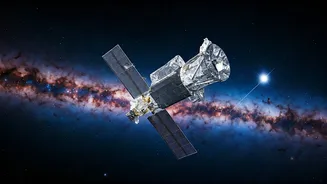
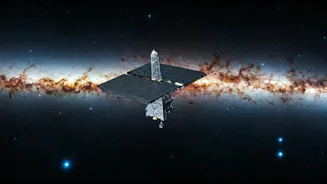
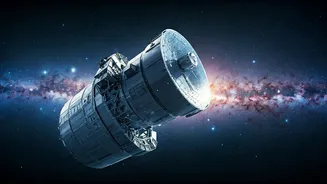
In a remarkable feat of project management, NASA’s Nancy Grace Roman Space Telescope is targeting a launch date of August 30, 2026, aboard a SpaceX Falcon Heavy rocket. [8, 12] This timeline puts the mission a full eight months ahead of its formal commitment
date of May 2027. [12, 15] The telescope arrived at Kennedy Space Center in Florida on June 21, 2026, to begin its final preparations for liftoff after years of assembly and testing at NASA's Goddard Space Flight Center. [11, 12] This accelerated schedule is a testament to the teams involved and sets an exciting tone for a mission designed to uncover the universe's deepest secrets. The final 70-day prelaunch campaign involves crucial steps like loading propellant and making final checks before the telescope is encapsulated for its journey to space. [12]
A Universe in Widescreen
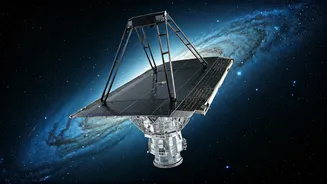
What makes Roman so special? Imagine having the power of the Hubble Space Telescope but with a view 100 times wider. That is the essence of Roman. [2, 5] It has a primary mirror that is 2.4 meters in diameter—the exact same size as Hubble's—allowing it to produce images with comparable sharpness and detail. [5, 14] However, its primary camera, the Wide Field Instrument (WFI), can capture an area of the sky more than 100 times larger than Hubble’s infrared camera in a single snapshot. [5, 16] This means one image from Roman will contain the detail of 100 Hubble images stitched together. [5] This enormous field of view transforms the telescope into a cosmic survey machine, capable of mapping vast sections of the sky with unprecedented speed and efficiency.
Hunting for Dark Energy and Exoplanets
Roman has two primary objectives that strike at the heart of modern cosmology. First, it will tackle the mystery of dark energy, the enigmatic force believed to be causing the universe's expansion to accelerate. [9, 10] By creating vast 3D maps of the universe and measuring the light from a billion galaxies, Roman will help scientists understand how dark energy has shaped the cosmos over time. [5, 10] Second, Roman will conduct a massive search for exoplanets using a technique called gravitational microlensing. [1, 9] This method can detect planets far from their star, planets with very low mass, and even 'rogue' planets that wander through the galaxy untethered to any star. The mission is expected to discover thousands of new worlds, providing a statistical census of planetary systems throughout our galaxy. [5]
A New Tool in the Cosmic Toolkit
Roman is not a replacement for Hubble or the James Webb Space Telescope (JWST), but a powerful and distinct complement. [17] If Hubble is a precision tool for zooming in on specific cosmic objects and Webb is an infrared powerhouse for peering back to the universe’s dawn, Roman is the wide-angle lens for creating enormous panoramas. [17, 18] While Hubble might spend weeks creating a 'deep field' image of a tiny patch of sky, Roman could survey an area hundreds of times larger to the same depth. [18] Its rapid survey capabilities will identify new and interesting targets that Hubble and Webb can then study in greater detail, ensuring all three flagships work in concert to advance our understanding.
The Legacy of a Visionary
The telescope is named in honor of Dr. Nancy Grace Roman, NASA's first chief of astronomy. [1, 9] Often called the 'Mother of Hubble' for her foundational role in getting that telescope built, her advocacy for space-based astronomy paved the way for missions like this. [19] Naming the observatory after her is a fitting tribute, as Roman builds on Hubble's legacy to take on even bigger cosmic questions. [14] Her vision was for astronomers to have ever-more-powerful tools to study the universe, and the Roman Space Telescope is a spectacular realization of that vision.