





Surface Tension Takes Charge
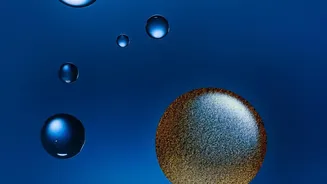
On Earth, if you spill water, gravity pulls it down into a puddle. In the microgravity environment of space, this downward pull is virtually gone. Instead, the dominant force becomes surface tension. Water molecules are naturally attracted to each other,
a property called cohesion. At the surface of a liquid, these molecules pull inward, creating a kind of elastic 'skin'. With no gravity to flatten it, this inward pull forces the liquid into the most efficient, low-energy shape possible: a perfect sphere. This is why any free-floating liquid in space, from a water droplet to a teardrop, forms a wobbly, mesmerizing orb.
A Sticky Situation
Beyond cohesion, water also exhibits adhesion—the tendency to stick to other surfaces. In space, this property is amplified. A floating sphere of water will cling to any surface it touches, whether it's a wall, a piece of equipment, or an astronaut's skin. This stickiness makes managing liquids a serious challenge. You can't simply pour water into a cup; it would just cling to the container's side or form a bubble over the rim. If a droplet breaks free, it won't fall and dry. It will float indefinitely until it hits a surface or is captured, posing a significant risk to sensitive electronics and control panels. Loose water could cause short circuits or damage vital equipment inside the space station.
How Astronauts Drink and Wash
So how do astronauts handle a substance that refuses to be poured? Through clever engineering. Drinking water is stored in sealed pouches, similar to juice boxes, and astronauts sip it through straws with special one-way valves. This prevents any stray droplets from escaping. Even for hot drinks like coffee, NASA has developed special 'zero-g' cups that use the principles of capillary action—the tendency of a liquid to be drawn into a narrow space—to guide the fluid to the rim for sipping. For washing, astronauts use no-rinse soaps and shampoos with a small amount of water from a pouch, using a towel to capture the moisture afterward. Every drop is precious.
Recycling Every Last Drop
Because launching water into space is incredibly expensive, recycling is essential for long-duration missions. The International Space Station is equipped with a sophisticated Environmental Control and Life Support System. This system captures moisture from every possible source: the humidity from astronauts' breath and sweat, condensation, and even urine. Through a multi-step process involving distillation, filtration, and catalytic oxidation, this wastewater is purified into clean drinking water. NASA has announced that the system now achieves a 98% water recovery rate, producing water that is often cleaner than what comes out of taps on Earth.
A Tool for Science
Studying how fluids behave without the interference of gravity is not just for show. These experiments have practical applications. Understanding fluid dynamics helps engineers design more efficient fuel tanks for satellites, ensuring every last drop of propellant can be used. Research into colloidal mixtures—fluids with tiny particles suspended in them—and other fluid physics phenomena on the ISS helps advance materials science and has applications back on Earth. Observing phenomena like capillary waves without gravity's influence can even help improve climate models for forecasting sea states on our own planet.