

For decades, we've understood the universe to be about 13.8 billion years old. But what if it were almost double that? A provocative new theory is challenging our cosmic timeline, suggesting our universe could be 26.7 billion years old.
Our Universe's Standard Origin Story
The prevailing
scientific consensus is that the universe began 13.8 billion years ago with the Big Bang. This is based on the Lambda-CDM model, a framework that has been incredibly successful at explaining many cosmic observations. These include the faint afterglow of the Big Bang, known as the cosmic microwave background, the large-scale structure of galaxies, and the accelerating expansion of the universe. The 'Lambda' in the name refers to the cosmological constant, a representation of dark energy which drives this expansion, while 'CDM' stands for 'cold dark matter', an invisible substance thought to provide the extra gravitational pull needed to form galaxies and hold them together. In this model, these two mysterious components, dark matter and dark energy, are believed to constitute about 95% of the cosmos.
A Wrinkle in Cosmic Time
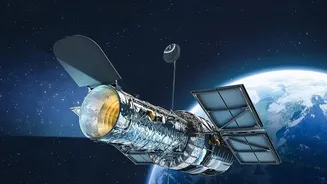
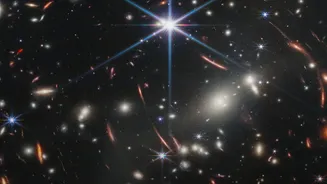
The Lambda-CDM model, for all its success, isn't perfect. One of the most significant recent challenges comes from NASA's James Webb Space Telescope (JWST). Peering deep into the cosmic dawn, JWST has spotted galaxies that are surprisingly massive and mature for their supposed age. According to the standard model, these galaxies existed when the universe was just a few hundred million years old, which shouldn't have been enough time for them to grow so large and complex. This 'impossible early galaxy' problem has prompted some scientists to question whether there's a missing piece in our understanding of either galaxy formation or the timeline of the universe itself.
A Radically Older Universe
One provocative solution comes from Rajendra Gupta, a physicist at the University of Ottawa. He and his colleagues have proposed a nonstandard model that nearly doubles the age of the universe to 26.7 billion years. Their framework is called the CCC+TL model, which stands for 'Covarying Coupling Constants plus Tired Light'. This model suggests that the fundamental forces of nature might not be constant and could have weakened over cosmic time. It also revives an old idea called 'tired light'. This combination offers a way to explain key cosmic features without the need for dark matter or dark energy, the two biggest unknowns in the standard model.
Tired Light and Shifting Constants
The 'tired light' theory, first proposed by Fritz Zwicky in 1929, suggests that photons (particles of light) lose energy as they travel across vast cosmic distances. This energy loss would make distant objects appear redder, an observation typically attributed solely to the expansion of the universe. While the tired light hypothesis on its own has been largely discredited because it conflicts with other observations, Gupta's model combines it with another concept: 'covarying coupling constants'. This part of the theory proposes that the fundamental physical constants that govern the interactions between particles have changed over time. Together, these two ideas reinterpret the redshift of distant galaxies, suggesting the light has traveled for much longer than previously thought, thus extending the age of the universe.
Solving Puzzles and Facing Skepticism
The main appeal of the CCC+TL model is that it seems to solve the 'impossible early galaxy' problem. By extending the age of the universe, it provides billions of extra years for those mature galaxies seen by JWST to form. Gupta argues that his model can explain the observed rotation of galaxies without dark matter and the universe's expansion without dark energy. However, the theory is far from mainstream. Most cosmologists remain confident in the Lambda-CDM model, which is supported by a much wider array of evidence. The CCC+TL model is a highly unconventional proposal that challenges deeply entrenched ideas. While parts of it have been tested against certain observations, the model still faces significant scrutiny and requires more evidence to be considered a serious contender to the standard model of cosmology.