



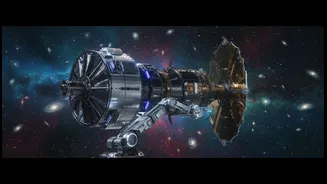


The Challenge of Deep Space Maintenance
For decades, space telescopes have been largely disposable. Once launched, they were on their own. The iconic Hubble Space Telescope was the exception, designed from the start to be serviced by astronauts on Space Shuttle missions. These daring spacewalks
replaced instruments and fixed failing components, dramatically extending Hubble's life and scientific returns. But such missions are incredibly expensive and risky. Furthermore, newer observatories like the James Webb Space Telescope (JWST) are positioned a million miles from Earth, far beyond the reach of any crewed mission. If a critical system fails or fuel runs low on these distant sentinels, it has historically meant the end of the mission.
A New Breed of Mechanic
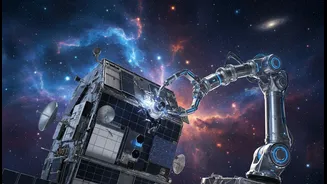
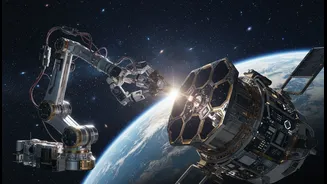
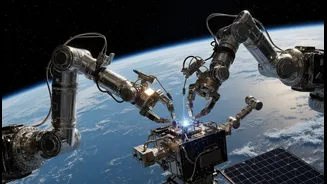
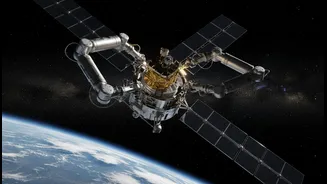
Enter the robotic mechanic. A new era of on-orbit servicing, assembly, and manufacturing (ISAM) is dawning, driven by both government agencies and a burgeoning commercial market. This technology promises to send sophisticated robots to rendezvous with, capture, and repair satellites that were never designed to be fixed. Just this month, in a landmark mission, a robotic servicing vehicle built by Katalyst Space Technologies was launched to rescue NASA's Neil Gehrels Swift Observatory. The spacecraft, called LINK, will attempt to autonomously dock with the aging telescope and boost it to a higher orbit, saving it from re-entering Earth's atmosphere and adding years to its scientific life. This mission, completed in just nine months on a relatively small budget, demonstrates a major shift toward agile, commercially-led solutions in space.
A Lifeline for Hubble and Beyond
The success of missions like LINK could pave the way for even more ambitious projects, including a potential robotic servicing mission to the Hubble Space Telescope. With its orbit slowly decaying, NASA has been exploring commercial proposals to reboost the legendary observatory, potentially adding many more years to its operational lifespan. In fact, NASA is now mandating that its next flagship mission, the $11 billion Habitable Worlds Observatory (HWO), be designed from the ground up for robotic servicing. Since HWO will operate at the same distant Lagrange point as JWST, human repair is not an option. Instead, its instruments will be modular, allowing a robotic servicer to slide out old components and plug in new, upgraded ones.
From Repair to In-Space Assembly
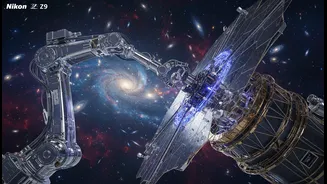
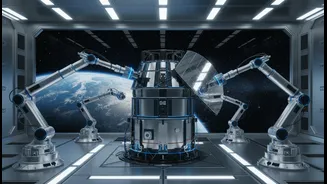
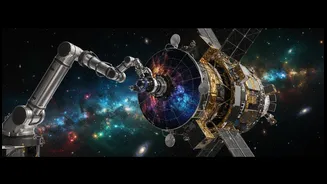
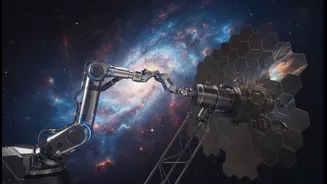
The true game-changer of this technology isn't just repairing old telescopes, but building entirely new ones in space. The size of a telescope's primary mirror is limited by the size of the rocket fairing it launches in. The JWST, with its 6.5-meter segmented mirror, represents the pinnacle of complex, foldable engineering. To see further and with greater clarity, we need even larger mirrors—10, 20, or even 100 meters in diameter. These cannot be launched in one piece. The future lies in launching smaller, modular components and using dexterous robots to assemble them in orbit. This approach would not only allow for unprecedentedly large observatories but could also reduce risk; a single launch failure wouldn't destroy the entire multi-billion dollar project.
The Growing Commercial Marketplace
This vision is fueling a rapidly growing commercial market for on-orbit services, projected to be worth billions of dollars. Companies like Northrop Grumman's subsidiary, SpaceLogistics, have already performed successful life-extension missions for commercial satellites in geostationary orbit. This sector is expanding beyond simple repairs and refueling to include debris removal, satellite repositioning, and ultimately, large-scale construction. The rise of this commercial ecosystem is critical, as it provides the services and develops the technologies that will enable the next generation of scientific discovery, transforming how we build, maintain, and operate our most critical assets in space.