


The Allure of Alien Oceans
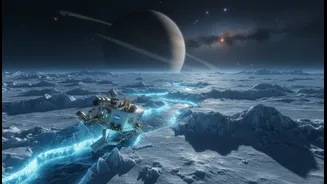
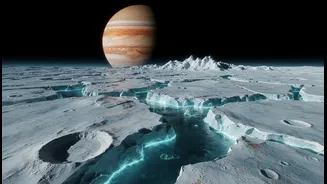
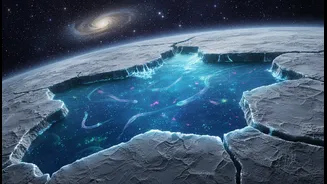
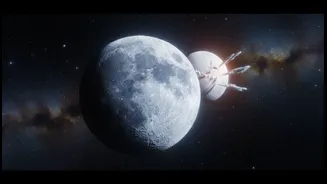
For decades, the mantra for finding life beyond Earth has been simple: 'follow the water'. That principle has led scientists to focus on the icy moons of our outer solar system. Worlds like Jupiter's moon Europa and Saturn's moon Enceladus are believed
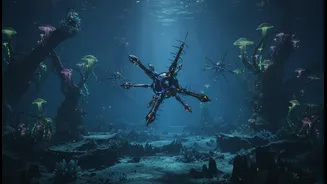
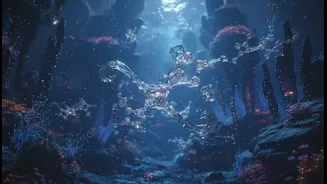
to hide vast, global oceans of liquid water beneath their frozen shells. Warmed by the gravitational tug-of-war with their giant parent planets, these dark oceans could contain the three key ingredients for life as we know it: liquid water, essential chemical elements, and an energy source, possibly from hydrothermal vents on the seafloor. The possibility that life could be swimming in these alien seas has made them prime targets for astrobiologists and the focus of upcoming missions.
The Problem of False Positives
Historically, the search for life involved looking for 'biosignatures'—a chemical, gas, or object that points to a biological origin. The problem is that nature is a great mimic. Scientists have come to realize that many potential signs of life can also be created by purely non-biological, or 'abiotic', processes. A certain gas in an atmosphere or a complex-looking molecule could be the result of weird geology or chemistry, not aliens. This has led to a history of ambiguous findings and premature claims, from the Martian meteorite ALH84001 in the 1990s to debates over methane on Mars. Announcing the discovery of extraterrestrial life is a claim that requires extraordinary evidence, and the scientific community realized it needed a better system to avoid crying wolf.
Raising the Bar: The New Framework
In response, NASA scientists have developed a new, more rigorous framework for evaluating evidence of life. Often called the 'Confidence of Life Detection' (CoLD) scale, it works like a ladder with seven rungs. A discovery moves up the ladder as more evidence is gathered. Finding a single potential biosignature is just the first step. To reach the top rung—conclusive proof of life—scientists must find multiple, independent lines of evidence that all point to a biological origin. Crucially, they must also demonstrate a deep understanding of the planet's environment and prove that no known abiotic process could have created the signal. It’s no longer enough to find a sign of life; you now have to rule out everything else.
What This Means for Future Missions
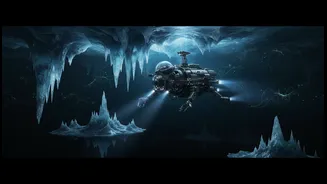
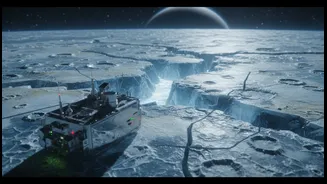
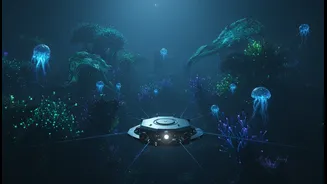
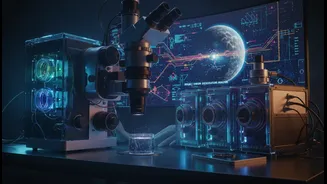
These stricter standards have major implications for how we design space missions. Instruments can no longer be built to just hunt for one specific molecule. Future probes and landers, like NASA's Europa Clipper and concepts for future missions, must carry a suite of instruments capable of making diverse, cross-verifying measurements. For example, a mission might need to not only detect organic molecules but also analyze their complexity, patterns, and the context of the surrounding geology to build a stronger case. Some research even suggests that simply sampling the plumes of water ice spraying from Enceladus might not be enough, as biological clues could be destroyed or altered on their journey from the deep ocean to the surface. This may require developing ambitious new technologies, like robotic cryobots that can drill through miles of ice to explore the oceans directly.
A New Era for Astrobiology Students
For students and early-career scientists, this shift redefines the field. Astrobiology is becoming even more interdisciplinary. Proving the existence of alien life will require a team of experts in geology, chemistry, biology, and data science all working together. Aspiring space-mission students will need to be trained not just to find a 'signal' but to understand the entire planetary system and debunk all possible non-biological explanations. The challenge is greater, but the work is more rigorous. The focus is shifting from a simple 'yes' or 'no' search to a more nuanced process of building confidence. This means the next generation of astrobiologists will be less like lone discoverers and more like meticulous cosmic detectives, building an airtight case one piece of evidence at a time.