



A New Shape in the South
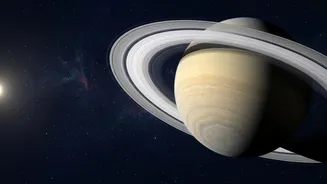
Planetary scientists are buzzing about a stunning and unexpected discovery: a massive, 10-sided atmospheric wave, or decagon, encircling Saturn’s south pole. Spotted in recent images from the Hubble Space Telescope, this enormous structure is a wave pattern
within a powerful jet stream. It measures roughly 104,000 miles across, with each of its ten distinct sides stretching longer than the diameter of Earth. This isn't some surface-level cloud pattern; observations suggest the decagon is a deep, vertically extended structure, rooted far down in the planet's thick atmosphere. Its discovery was made possible only recently, as Saturn’s long, tilted orbit finally brought its southern pole back into clear view from Earth after more than a decade in shadow.
The Hexagon's Mysterious Sibling
The discovery of a southern decagon immediately draws comparisons to Saturn's most famous atmospheric feature: the northern hexagon. First spotted by the Voyager probes over 40 years ago, the hexagon is a remarkably stable, six-sided jet stream that has mystified scientists for generations. It was long considered a unique oddity in the solar system. The new decagon proves that is not the case. However, the two are not identical twins. The hexagon has been a steady, persistent feature for at least four decades, while the decagon appears to be a recent development. NASA's Cassini spacecraft, which orbited Saturn from 2004 to 2017, saw no evidence of a long-lived polygonal storm in the south, suggesting the decagon formed sometime after the mission ended.
More Than Just a Pretty Pattern
The geometric precision of these storms may be beautiful, but their real value is in the physics they reveal. These polygons are not solid objects but standing waves locked within powerful jet streams that circle the planet’s poles. The number of sides in the polygon—six in the north, ten in the south—is directly related to the specific properties of the jet stream that carries it, such as its speed, width, and the temperature gradients in the atmosphere. The fact that one pole formed a hexagon and the other a decagon tells scientists that the atmospheric conditions in Saturn’s two hemispheres are significantly different. This provides a crucial new set of constraints for computer models that aim to simulate how gas giant atmospheres behave.
Rewriting the Rules of Planetary Weather
For years, the northern hexagon was treated as a one-off spectacle. Its existence was a puzzle, but with no other examples to compare it to, our understanding was limited. The emergence of the decagon fundamentally changes the game. It confirms that forming giant, stable, geometric storms is a process that is likely inherent to Saturn's atmosphere, given the right conditions. Scientists are no longer trying to explain a single anomaly; they are now working to understand a fundamental behaviour of gas giants. The key question has shifted from 'Why does Saturn have a hexagon?' to 'Why does Saturn produce polygons, and what determines their shape?'. This discovery presents a rare opportunity to watch a massive atmospheric pattern evolve in near real-time, providing invaluable data on the forces that shape the weather on these enormous, turbulent worlds.