





The Philosophy of 'Less'
Before it was an Instagram hashtag, minimalism was a revolutionary idea. Its modern DNA can be traced back to the early 20th-century Bauhaus school in Germany, which championed the motto "form follows function." Architects like Ludwig Mies van der Rohe
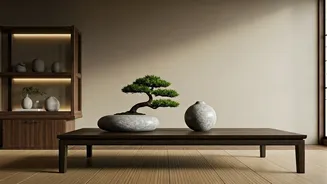
argued for radical simplicity, stripping away ornamentation to reveal a building's essential structure. For them, "less is more" wasn't about emptiness; it was about clarity and honesty in design. This principle rejected the cluttered, ornate styles of the past in favor of clean lines and practical materials. Parallel movements in Japanese culture, rooted in Zen Buddhism, have long celebrated concepts like *Ma* (the beauty of empty space) and *Wabi-sabi* (finding beauty in imperfection and simplicity). These aren't trends that fade with the seasons; they are centuries-old philosophies about finding peace and purpose by focusing on the essential. This rich history proves that minimalism has always been about more than just how a room looks—it's about a way of thinking.
Clearing Out Your Headspace
The enduring appeal of minimalism has a powerful psychological component. We live in an era of constant stimulation, and our brains pay the price. Every object in your field of vision, every notification on your phone, and every item on your to-do list competes for a finite amount of mental energy. This creates a state of low-grade cognitive overload. A cluttered environment can subtly increase cortisol, the stress hormone, and contribute to anxiety and distraction. Minimalist design works as a visual antidote. By consciously reducing the number of possessions and simplifying a space, you lower the amount of sensory information your brain has to process. This isn't about deprivation; it's about creating an environment of calm and focus. The act of decluttering itself can be therapeutic, helping you take control and make intentional choices about what you value. In a world that constantly asks for our attention, a minimalist space offers a rare gift: a place for your mind to rest.
An Antidote to Modern Excess
Minimalism's resurgence in the 21st century is no accident. It stands in direct opposition to the dominant culture of hyper-consumerism. For decades, the message has been to acquire more: the latest gadget, the fast-fashion haul, the bigger house. Minimalism offers a compelling counter-narrative: what if happiness comes not from adding, but from subtracting? This resonates deeply with growing concerns about sustainability. By embracing a "buy less, but better" mentality, minimalism encourages conscious consumption. It means investing in well-made, durable items that you truly love and need, rather than accumulating cheap, disposable goods that quickly end up in landfills. It’s a quiet rebellion against the endless cycle of wanting and waste. This makes minimalism less of a design style and more of a personal economic and environmental statement. It’s about aligning your physical surroundings with your values, choosing intention over impulse.
Finding Quiet in a Digital World
Today, the most significant source of clutter isn't in our closets; it's in our pockets. The principles of minimalism are arguably more relevant than ever when applied to our digital lives. Think of the endless notifications, the sprawling mess of files on your desktop, the hundreds of unread emails, and the infinite scroll of social media. This is digital maximalism, and it's designed to exhaust our attention. Digital minimalism applies the same core ideas—remove what's unnecessary to focus on what's valuable. This can mean unsubscribing from email lists, turning off non-essential notifications, curating your social media feeds to only show content that enriches you, and deleting apps you don't use. Just as a clean room provides a sense of peace, a simplified digital environment reduces anxiety and allows for deeper, more focused work and more present, meaningful leisure.