




The Sun’s Unseen Fury
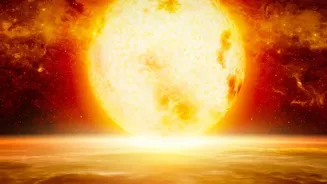
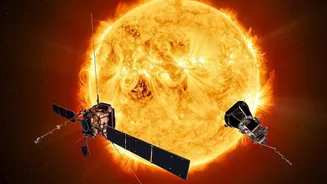
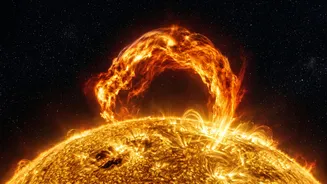
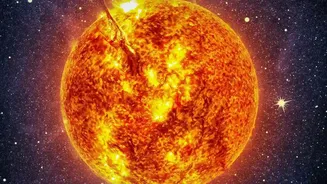
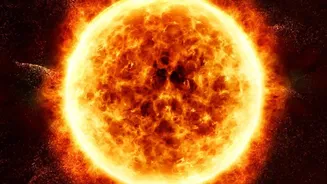
Imagine a storm not of wind and rain, but of superheated gas and magnetic fields, travelling at millions of kilometres per hour. This is a solar storm, or more specifically, a coronal mass ejection (CME). These are colossal eruptions from the sun's outer
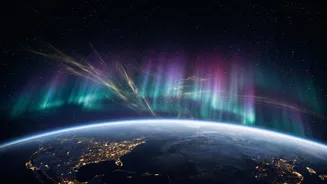
atmosphere, the corona, that can launch billions of tonnes of plasma into space. While Earth’s magnetic field protects us from the worst of the sun's constant stream of particles, a direct hit from a powerful CME is a different matter entirely. These events can trigger intense geomagnetic storms upon reaching our planet, interacting with our magnetic shield in ways that can have serious consequences on the ground.
When Space Weather Hits Home
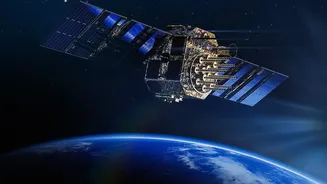
The risks are not hypothetical. In 1859, the Carrington Event, the most intense solar storm on record, set telegraph stations on fire and created auroras so bright people could read newspapers by their light. If a storm of that magnitude happened today, the impact would be catastrophic. Our hyper-connected world is uniquely vulnerable. Geomagnetic storms can induce powerful electrical currents in long conductors like power lines, potentially overloading transformers and causing widespread, long-lasting blackouts. A 1989 storm did just that, plunging Quebec into darkness for 12 hours. Beyond the grid, these storms can disrupt high-frequency radio communications, damage satellite electronics, and interfere with GPS signals, affecting everything from aviation and shipping to banking and emergency services.
The Challenge of Forecasting Storms
For years, the problem hasn't been seeing the storms coming, but knowing what they'll do when they arrive. Solar observatories can spot a CME as it leaves the sun, giving us a one- to three-day heads-up that something is headed our way. But predicting its specific impact—where on Earth the effects will be felt and how severe they will be—has been notoriously difficult. Previous models could only offer rough estimates, often with too little precision or lead time for authorities and companies to take meaningful protective action. It was like knowing a cyclone is in the ocean, but not knowing which city it will hit or how strong it will be on landfall.
Introducing the AI Forecaster: DAGGER
This is where a new AI model changes the game. Developed by an international team of researchers at the Frontier Development Lab (FDL), a public-private partnership that includes NASA, the model is called DAGGER (Deep Learning Geomagnetic Perturbation). DAGGER isn't designed to predict the CME itself, but to provide rapid and accurate forecasts of the geomagnetic disturbances it will cause on Earth. The project's lead author, Vishal Upendran of India's Inter-University Centre for Astronomy and Astrophysics, highlighted its potential to minimize or even prevent devastation to modern society.
A Crucial 30-Minute Warning
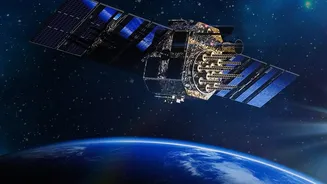
The key breakthrough of DAGGER is its speed and precision. By analyzing real-time data from solar-observing satellites, the AI can predict the location and severity of a geomagnetic disturbance just 30 minutes before it happens. The model, which was trained on vast amounts of historical data from solar missions and ground-based observatories, can generate a worldwide forecast in less than a second and update it every minute. This 30-minute lifeline is invaluable. While it's not enough time to build new defenses, it is enough time for utility companies to take preventative measures to protect their grids, for satellite operators to put their expensive hardware into a protective safe mode, and for airlines to avoid communication blackouts on polar routes.
Why This Matters for India
For a rapidly digitizing nation like India, this technology is particularly crucial. Our economy's reliance on stable power, satellite communications, and digital infrastructure grows every day. Initiatives like Digital India, the widespread use of UPI for payments, and our dependence on GPS for logistics and navigation all make the country vulnerable to the chaos of a major solar storm. An accurate 30-minute warning could be the difference between a manageable disruption and a crippling blow to the economy and daily life. It provides a critical window to protect the technological backbone that our modern society is built upon, ensuring that when the sun flares up, our lights stay on.