




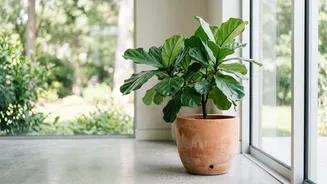
Have you noticed your favourite houseplant starting to lean, with one side flourishing while the other looks a bit bare? This common issue has a simple fix: rotation. Here are the essentials for promoting healthy, even growth on all your indoor plants.
The Science of the Lean
The reason your plant leans towards the window is a natural process called phototropism. Plants survive by converting light into energy through photosynthesis, so they instinctively grow towards the strongest light source available. This response is driven by a plant hormone called auxin, which accumulates on the shaded side of the stem. These auxins cause the cells on the darker side to grow longer, effectively pushing the plant's leaves and stem towards the light to maximize energy absorption. While this is a brilliant survival tactic in nature, in a home with a single window as a light source, it results in lopsided, uneven growth.
The Art of the Turn: How and When
The solution is simple: rotate your plant. The most common and effective method is the quarter-turn technique. A good rule of thumb is to give your plant a 90-degree turn in the same direction every time you water it. This creates a consistent routine and ensures that over a month or so, all sides of the plant will have had their time in the sun. For plants in lower light, a turn every few weeks is beneficial, while those in very bright spots might only need it every couple of months. The key is consistency. This regular rotation prevents one side from dominating growth, leading to a stronger, more symmetrical, and visually balanced plant.
When Not to Rotate
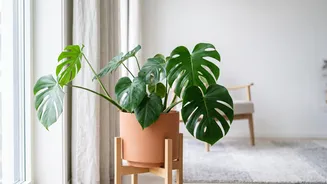
While most houseplants benefit from regular turning, there are exceptions. Plants that have a distinct 'front' and 'back', like climbing Monsteras or Philodendrons, often do better when left alone. These plants are climbers by nature and create an internal architecture with aerial roots at the back and leaves facing the front; rotating them can disrupt this pattern and cause chaotic, twisted growth. Similarly, it's best to avoid rotating flowering plants like orchids or Christmas cacti once they have set their buds. The sudden change in light orientation can stress the plant and cause it to drop its buds before they bloom. Trailing plants, like Pothos, can often be left to cascade naturally towards the light without intervention.
Beyond Rotation: Other Keys to Even Growth
Rotation is a powerful tool, but it can't fix underlying issues. It's crucial to ensure your plant is getting enough light in the first place. Rotation redistributes light exposure; it doesn't create more light. If a plant is stretching with long, weak stems and pale leaves, it needs a brighter spot, not just a turn. Additionally, keep the leaves clean. Dust and grime can block light and inhibit photosynthesis. Gently wiping leaves with a damp cloth allows the plant to make the most of the light it receives. Finally, consider pruning to manage shape and size. Trimming back leggy branches can encourage bushier, fuller growth all around.
Common Mistakes to Avoid
While wellintentioned, some rotation habits can do more harm than good. One common mistake is rotating too frequently or dramatically, which can stress the plant as it constantly has to readjust. A gentle quarterturn is much better than a sudden 180degree spin. Another pitfall is using rotation to compensate for a poor location. If a room is too dark, no amount of turning will make the plant healthy; it will simply stretch out weakly in all directions. Lastly, don't feel a need to achieve perfect, unnatural symmetry. A slight lean is a normal plant behaviour, and embracing that can be part of the beauty of having living things in your home.