






The STRIDE for Smarter Mobility
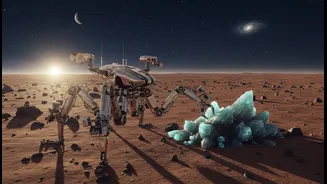
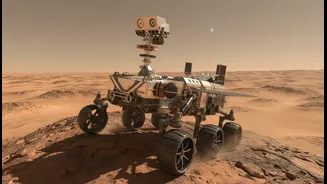
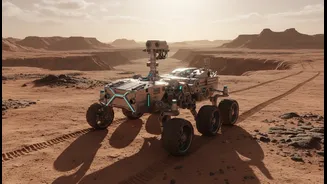
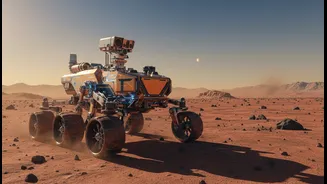
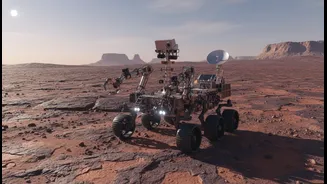
The key to unlocking Mars's secrets lies in our ability to access its most challenging and scientifically interesting regions. Current rovers, while successful, are limited by terrain and distance. To overcome this, NASA has launched the Science Transport
and Robotic Innovation for Deployment and Exploration (STRIDE) initiative. With a total potential value of around $17 million, STRIDE aims to foster the development of innovative robotic systems—both on the ground and in the air—that can travel farther and navigate more complex landscapes than ever before. This public-private partnership model allows NASA to tap into commercial innovation, accelerating the creation of technologies crucial for future robotic and, eventually, human missions to the Red Planet.
AeroVironment: From Air to Martian Air
Based in Arlington, Virginia, AeroVironment is no stranger to Martian skies. The company was instrumental in the success of the Ingenuity Mars Helicopter, which proved powered, controlled flight was possible in the thin Martian atmosphere. Their selection for the STRIDE program leverages this unique expertise, positioning them to potentially develop more advanced aerial exploration platforms that can act as scouts or access areas completely impassable for ground-based rovers. This continues their legacy of pioneering new forms of robotic exploration in challenging environments.
Astrobotic: From the Moon to Mars
Pittsburgh’s Astrobotic has become a major player in the commercial lunar space, developing landers and rovers for missions to the Moon. This experience in creating robust mobility systems for extraterrestrial surfaces makes them a natural fit for the STRIDE initiative. By applying lessons learned from the harsh lunar environment, Astrobotic is positioned to help design robotic systems capable of withstanding the rigors of Mars, including its dusty surface and extreme temperature swings. Their involvement signals a pivot from lunar expertise to interplanetary applications.
Venturi Astrolab: Building the Martian Rove
Hailing from Hawthorne, California, Venturi Astrolab is focused squarely on the challenge of surface mobility. The company is already developing its Flexible Logistics and Exploration (FLEX) rover, designed to transport cargo and eventually astronauts on planetary surfaces. Their inclusion in STRIDE suggests NASA is interested in their forward-thinking approach to creating versatile and highly capable rovers. Their work under this program could directly influence the design of future vehicles that serve as workhorses for science and logistics on Mars.
Honeybee Robotics: The Digging and Drilling Experts
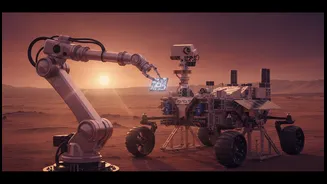
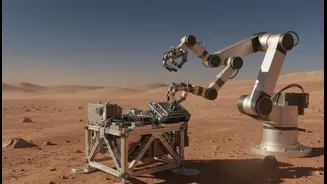
For decades, Honeybee Robotics of Longmont, Colorado, has been the go-to expert for creating specialized robotic tools for NASA, including rock-grinding tools and sample collection systems used on multiple Mars rovers. Their expertise lies in the intricate mechanics of interacting with planetary surfaces. Under STRIDE, their deep knowledge will be invaluable in designing mobility platforms that don't just travel but can also perform complex tasks, potentially integrating drilling and sampling capabilities into more mobile and autonomous systems.
Intuitive Machines: Expanding Interplanetary Horizons
Houston-based Intuitive Machines has made a name for itself with its successful commercial lunar lander missions. Like Astrobotic, their proven ability to design, build, and operate spacecraft in deep space is a significant asset. Their selection for STRIDE indicates a strategic expansion of their capabilities beyond the Moon. The company can now apply its expertise in landing and surface operations to the unique challenges of Mars, contributing to the development of sophisticated mobility systems for a completely different world.
Ground Control Robotics and MEI Technologies
Rounding out the selections are two more innovative firms. Ground Control Robotics of Atlanta, Georgia, is focused on developing robotic systems for challenging environments, bringing fresh perspectives to Martian mobility. MEI Technologies of Webster, Texas, now part of Aegis Aerospace, offers extensive experience in engineering and technology integration for the aerospace sector. Their inclusion ensures a broad base of expertise, from specialized robotics to the complex systems engineering required to make these advanced concepts a reality on another planet. Together, these seven companies form a diverse coalition poised to redefine how we explore our planetary neighbor.