




The Most Dangerous Minutes
After days in orbit, the most complex and risk-prone stage of the Gaganyaan mission begins. The crew module will slam back into Earth's atmosphere at blistering speeds, generating temperatures of thousands of degrees. While a state-of-the-art heat shield
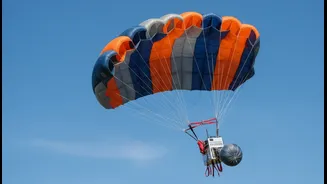
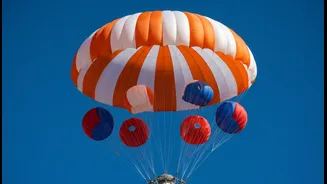
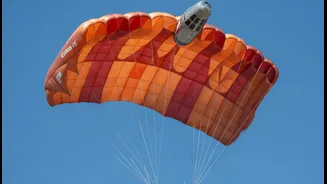
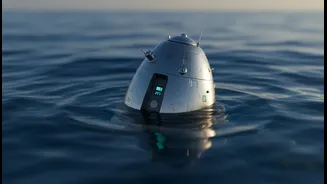
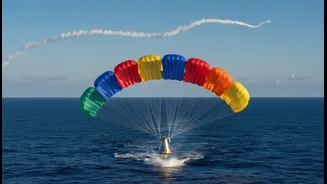
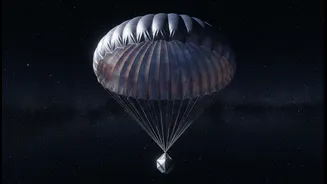
protects the astronauts, the capsule must then decelerate from hypersonic velocity to a speed safe enough for landing. This is achieved through a meticulously choreographed sequence involving ten parachutes of different types. The final act is the splashdown itself. Those moments, from atmospheric re-entry to bobbing in the sea, are fraught with danger. A mistake at any stage could be catastrophic, which is why every variable must be tested to perfection.
Why Water, Not Land?
Choosing a landing site is a critical decision balancing geography, safety, and logistics. While nations with vast, empty deserts might opt for land-based touchdowns, India's geography makes a water landing the more practical choice. More importantly, water is an excellent natural shock absorber. A sea landing can tolerate a higher impact velocity (around 7-9 metres per second) compared to the very slow touchdown (1-2 metres per second) required for solid ground. Achieving such a low speed with parachutes alone would require impractically large canopies, adding significant weight and complexity to the capsule. The ocean provides a massive, flat, and forgiving target, reducing the risk compared to a precise ground landing that requires extra systems like retrorockets.
Testing for Worst-Case Scenarios
ISRO's research isn't just about a perfect, nominal landing. It's about ensuring the crew's survival even if things go wrong. The "high-impact" aspect of the research involves simulating off-nominal conditions. What happens if the capsule hits the water at a steep angle? What if the sea is rough with high waves? What if some parachutes fail to deploy correctly? To answer these questions, ISRO uses a Crew Module Recovery Model (CMRM) that mimics the mass, dimensions, and centre of gravity of the actual capsule. This mock-up is subjected to a series of drop tests and recovery trials to validate procedures for every imaginable scenario.
The Science of a Safe Splashdown
Ensuring a safe landing involves more than just slowing down. The crew module must remain stable and upright in the water to allow the astronauts to exit safely. ISRO and the Indian Navy conduct extensive trials at the Water Survival Test Facility (WSTF) in Kochi. These tests perfect the sequence of operations post-splashdown: detaching the parachutes to prevent entanglement, inflating flotation bags to keep the module from sinking or tipping over, and activating beacons for recovery teams to locate it swiftly. Recent tests have focused on validating the main parachute systems, dropping test articles from aircraft to confirm their strength and reliability under maximum load conditions. The Indian Navy also practices the intricate process of bringing the capsule into a ship's well deck, a floodable bay that allows for a smooth and secure recovery.
It's All About the Astronauts
Ultimately, every test and simulation is centred on one thing: human safety. The minutes following splashdown are critical. The crew must be prepared for any situation, from calm seas to high waves. The joint exercises with the Indian Navy are designed to perfect the crew egress protocols—the difficult task of exiting the cramped module and getting into life rafts while waiting for the recovery ship. This specialised training prepares the 'Gaganyatris' to handle post-landing survival in the open ocean. ISRO’s meticulous focus on water landing research is a direct reflection of its commitment to bringing its astronauts home safely, a non-negotiable final step for a successful human spaceflight mission.