

Why We Follow the Water
On Earth, all life as we know it requires water. This simple fact makes water a key 'biosignature' for astronomers scanning the cosmos. Finding liquid water, or even water vapour, is the first step in assessing if a distant exoplanet could potentially
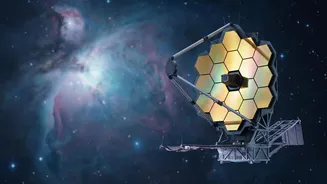
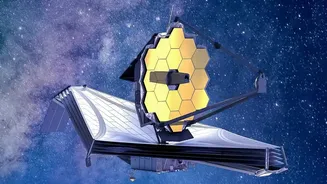
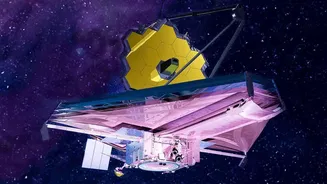
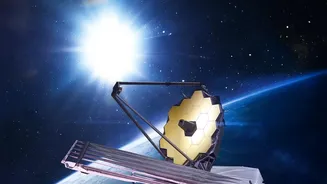
be habitable. Before the James Webb Space Telescope, we had hints of water on some exoplanets, but our view was blurry. JWST was designed to change that. Its powerful instruments can analyse the chemical makeup of alien atmospheres with unprecedented precision, turning the search for water from a hopeful guess into a detailed investigation.
How Webb 'Sees' Water Vapour
JWST doesn't look at planets directly to see oceans or clouds. Instead, it uses a technique called transmission spectroscopy. When an exoplanet passes in front of its star from our perspective, a tiny fraction of the starlight filters through the planet's atmosphere. Different molecules in that atmosphere absorb specific wavelengths, or colours, of light. Water vapour, methane, and carbon dioxide each have a unique light signature. By capturing the spectrum of light that passes through, Webb can identify the chemical fingerprints of the gases present, essentially giving us a chemical inventory of a world hundreds of light-years away.
A Complex and Patchy Picture
What JWST is revealing is that the distribution of water on exoplanets is far from simple. It’s not just a matter of whether a planet has water or not, but where it is and what form it takes. For example, on the 'fluffy' exoplanet WASP-107b, Webb found not only water vapour but also clouds made of silicate sand. This suggests a dynamic atmosphere where different materials are transported and mixed. On another planet, GJ 486 b, hints of water vapour were detected, but scientists are cautiously working to determine if the signal is from the planet's atmosphere or from cool spots on the star itself. This complexity shows that atmospheres are not uniform blankets; they are active, three-dimensional systems.
Case Study: The K2-18 b Puzzle
One of the most intriguing targets for Webb has been K2-18 b, a planet about 8.6 times the mass of Earth that orbits within its star's habitable zone. Early observations with the Hubble telescope suggested the presence of water vapour. JWST's more powerful gaze confirmed this and also detected methane and carbon dioxide. However, some studies also noted a lack of water vapour in certain atmospheric layers, leading to a theory of a 'cold trap' where water might be frozen out at certain altitudes. The data has been interpreted in various ways, suggesting K2-18 b could be a 'Hycean' world with a water ocean under a hydrogen-rich atmosphere, or a gassier mini-Neptune. This ongoing investigation highlights how Webb's data is creating more nuanced and challenging questions.
Beyond Water: A Chemical Cocktail
While water is crucial, it's just one piece of the puzzle. JWST is finding that the presence or absence of other molecules provides vital context. On K2-18 b, the detection of carbon-bearing molecules like methane and carbon dioxide, alongside water, supports the idea of a potential water ocean. On WASP-107b, the presence of sulfur dioxide but the surprising lack of methane points to a specific and unusual atmospheric chemistry. In another recent discovery, scientists using Webb even detected 'semi-heavy water' (HDO) on the planet WASP-39b, where one hydrogen atom is replaced by a heavier isotope. Studying the ratios of these different molecules helps scientists piece together the history of a planet, including how it formed and migrated.