


The High-Stakes Traffic Jam Above
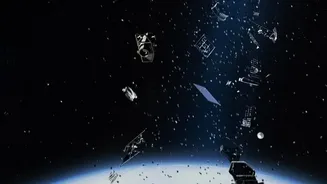
Low Earth Orbit (LEO) is the busiest highway you’ve never seen. It’s a critical region of space, packed with thousands of satellites that provide everything from GPS and weather forecasting to global communications. But decades of launches have turned
it into a junkyard. It is estimated there are over 7,600 tonnes of debris, from defunct satellites and spent rocket stages to tiny flecks of paint. While it may sound harmless, even a small object can be catastrophic. In LEO, objects travel at speeds approaching 30,000 miles per hour. A collision with a piece of debris the size of a coffee cup could strike with the force of a hand grenade, obliterating a multi-million dollar satellite and creating thousands of new pieces of junk in the process. Experts have long feared a scenario known as the Kessler Syndrome, a runaway chain reaction of collisions that could render LEO unusable for generations.
Enter the Cosmic Janitors
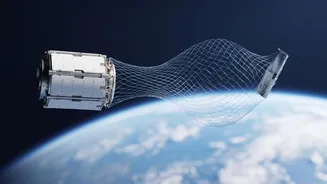
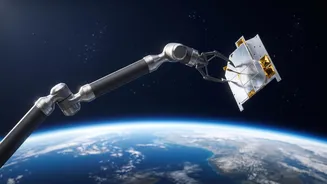
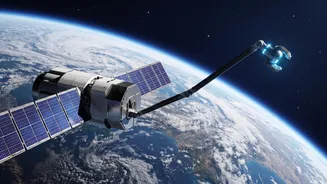
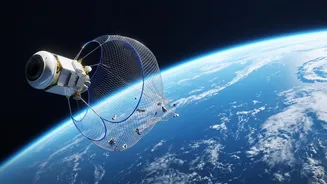
Cleaning up this mess is one of the most significant challenges facing the modern space industry. You can't simply send up a garbage truck. The targets are uncontrolled, often tumbling, and moving at incredible speeds. In response, agencies like the European Space Agency (ESA) and commercial partners are developing active debris removal (ADR) missions. These initiatives are shifting from theory to real-world testing of several creative solutions, including nets, robotic arms, and two of the most compelling concepts: harpoons and lasers. The goal isn't just tidiness; it's about preserving the vital infrastructure that underpins our global economy and daily routines.
How the Harpoon Works
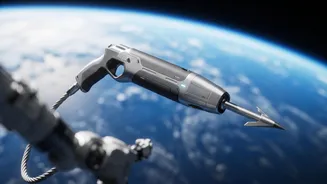
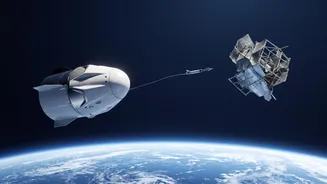
The concept of using a harpoon is as old as whaling, but its application in space is cutting-edge. A chaser satellite would first rendezvous with a large piece of debris, like a dead satellite. After matching its rotation, it would fire a tethered harpoon at the target from a close distance. The projectile is designed to pierce the target's hull and deploy barbs to ensure a secure grip, allowing the chaser to then drag the debris into a lower orbit where it will burn up harmlessly in Earth's atmosphere. The technology was successfully demonstrated in orbit by the RemoveDEBRIS mission, a project led by the University of Surrey and involving a consortium of companies, including Airbus. In a key 2019 test, a harpoon was fired at 20 meters per second, successfully penetrating a target panel extending from the main spacecraft. This test proved the fundamental viability of capturing debris this way.
The Promise of Laser Brooms
While harpoons are designed for large objects, lasers offer a solution for the millions of smaller, untrackable pieces of junk. The idea, sometimes called a "laser broom," involves using a powerful ground-based or space-based laser to target debris. The laser doesn't destroy the object outright. Instead, it fires a pulse of energy that vaporizes a tiny layer of the object's surface. This creates a small puff of gas that acts like a micro-thruster, nudging the debris and altering its trajectory. By repeatedly zapping an object, its orbit can be lowered enough for it to re-enter and burn up in the atmosphere. ESA is actively exploring this concept with its OMLET (Orbit Maintenance via Laser Momentum Transfer) project, which aims to use ground-based lasers to prevent collisions. Chinese researchers and NASA have also studied the concept, viewing it as a cost-effective way to handle the dangerous 1-to-10-centimeter class of debris.
The Next Frontier in Orbital Cleanup
The term "laser harpoon" is more of a catch-all for these distinct but complementary technologies rather than a single device. Harpoons physically capture large targets, while lasers offer a contactless method for nudging smaller ones. While successful demonstrations like the RemoveDEBRIS mission have been a huge step forward, these technologies are not yet widely deployed in an operational capacity. The challenges are immense, from the cost of missions to the legal and political questions surrounding the handling of objects owned by other nations. However, with the space economy booming and LEO becoming more crowded, the transition from experimental tests to repeatable, commercial debris removal services is seen as an inevitability. Companies are already partnering to create "Debris Removal as a Service" platforms, signaling a new commercial frontier focused on keeping space safe and sustainable.