



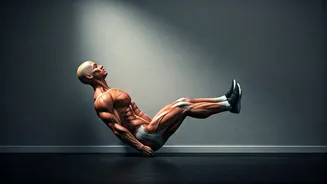


Unlocking ‘Weightless’ Strength
First, let's decode the term 'weightless strength'. It isn’t about defying gravity; it’s about mastering it. This is functional strength, the kind that integrates your entire body to move efficiently and powerfully. While lifting heavy weights builds
significant muscle and power, it often happens in isolated, linear planes of motion. Weightless, or bodyweight, strength is about dynamic stability, coordination, and the ability to control your own mass through complex movements. It’s the strength of a gymnast or a martial artist — powerful, agile, and coordinated. Crawling is a foundational pillar of this type of training, forcing your muscles to work together as a single, cohesive unit.
The Primal Power of Crawling
As toddlers, crawling is how we built the foundational core strength and cross-body coordination needed to walk, run, and climb. As adults, revisiting these patterns can be transformative. When you crawl, you’re engaging in a contralateral movement (opposite arm and leg moving together), which strengthens the neural pathways between the left and right hemispheres of your brain. Your core has to work overtime to prevent your torso from rotating, building deep abdominal stability that protects your spine. Your shoulders, wrists, and hips are also put to the test, improving both their stability and mobility under load. It’s a full-body workout disguised as a simple movement.
The Foundational Crawl: Bear Crawl
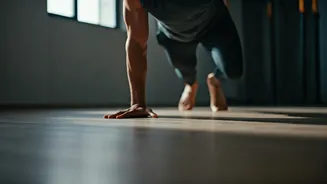
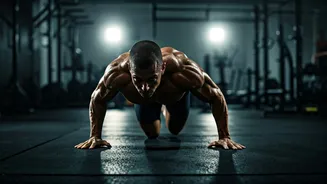
This is your starting point. The bear crawl builds the essential stability and control needed for more advanced variations. How to do it: Start on all fours with your hands directly under your shoulders and your knees under your hips. Press into your hands and toes to lift your knees just an inch or two off the floor — this is the key to engaging your core. Your back should be flat, like a tabletop. To move, take a small step forward with your right hand and left foot simultaneously, then your left hand and right foot. Keep your hips low and stable; avoid swaying side-to-side. The goal is slow, controlled movement, not speed.
The Mobility Challenge: Lizard Crawl
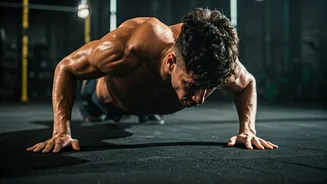
Also known as the Spiderman Crawl, this variation adds a significant mobility and coordination challenge. It’s a fantastic movement for opening up the hips and thoracic spine. How to do it: Start in a push-up position. To move, bring your right foot up to the outside of your right hand as you simultaneously move your left hand forward. Your body should be low to the ground. Then, alternate sides, bringing your left foot to your left hand as you move your right hand forward. This movement is fluid and snake-like. It requires more flexibility and control than the bear crawl, so focus on achieving a full range of motion with each step.
The Posterior Powerhouse: Crab Walk
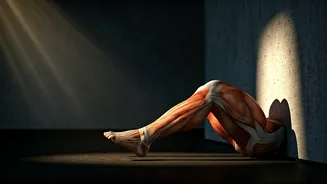
Crawling isn’t just a forward-facing exercise. The crab walk flips the script, targeting the often-neglected posterior chain — your glutes, hamstrings, and back — along with your triceps and shoulders. How to do it: Sit on the floor with your knees bent and feet flat. Place your hands on the floor behind you, fingers pointing towards your feet. Lift your hips off the ground until your torso is parallel to the floor. This is your starting position. From here, ‘walk’ forward or backward by moving your opposite hand and foot in unison. Keep your hips high throughout the movement to maximise glute and hamstring engagement.
How to Use Crawls in Your Workout
You don't need to dedicate an entire day to crawling. Their versatility is one of their greatest strengths. Use them as a dynamic warm-up for 5-10 minutes to activate your core and shoulders before a lifting session. Alternatively, integrate them into a high-intensity interval training (HIIT) circuit: try 40 seconds of bear crawls followed by 20 seconds of rest. Or, use them as a brutal workout ‘finisher’. After your main workout, set a timer for 5 minutes and see how much distance you can cover with a combination of different crawls. Your muscles will be burning, and your heart rate will be soaring.