





The Fiery Problem of Re-Entry
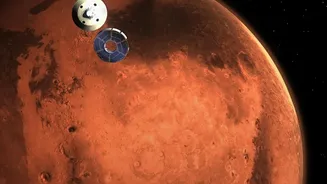
Bringing a probe home from space or landing one on another planet with an atmosphere, like Mars, involves a terrifyingly delicate dance with physics. As a spacecraft plummets from the vacuum of space, it hits the atmosphere at hypersonic speeds, travelling
many times faster than the speed of sound. This rapid compression of air in front of the vehicle generates immense heat, with temperatures soaring to 1,650°C or even higher. Without protection, any spacecraft would be incinerated in moments. This thermal challenge has been a fundamental problem since the dawn of the space age, requiring robust Thermal Protection Systems (TPS) to act as a barrier, absorbing and dissipating the life-threatening heat to keep the probe and its precious cargo safe.
The Old Guard: Rigid Heat Shields
The traditional solution has been the rigid heat shield. Think of the ablative shields on the Apollo capsules, designed to char and flake away, carrying heat with them, or the ceramic tiles of the Space Shuttle, which absorbed and radiated heat back into the atmosphere. These systems have a long and successful history, protecting countless missions. However, they have a major limitation: size. A rigid heat shield cannot be any larger than the diameter of the rocket fairing—the nose cone that protects the payload during launch. This physical constraint limits the size and weight of payloads we can safely land, a significant bottleneck for ambitious future missions, especially to Mars.
Enter the Inflatable Solution
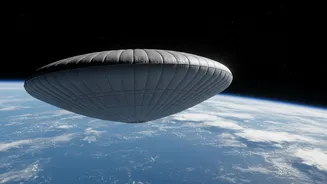
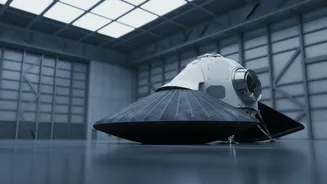
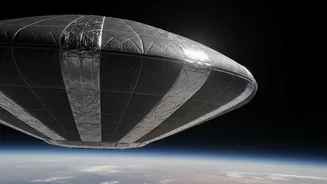
This is where inflatable heat shields, officially known as Hypersonic Inflatable Aerodynamic Decelerators (HIADs), come in. Developed by NASA, this technology is designed to be packed compactly for launch and then inflated like a giant, ultra-resilient balloon just before atmospheric entry. Because it deploys in space, a HIAD can be much larger than any rigid shield, creating more drag. This increased surface area allows the spacecraft to begin decelerating higher up in the thinner parts of the atmosphere, leading to a slower and cooler descent. This breakthrough effectively shatters the limitations imposed by rocket fairings, opening up a new world of possibilities.
The Science of a Softer Landing
So, how does an inflatable object survive conditions that can vaporize steel? The magic is in its advanced, multi-layered materials. The inflatable structure itself is made of stacked rings, or tori, woven from synthetic polymers that are pound-for-pound stronger than steel. This structure provides the shape and rigidity once inflated. The crucial thermal protection comes from the flexible outer layers. This 'skin' is a high-tech fabric made of advanced ceramic fibers, capable of withstanding the extreme temperatures of re-entry. Beneath this outer layer are flexible insulation materials that prevent heat from reaching the inflatable structure. Together, these components act as both a brake and a shield, dramatically reducing the thermal load on the spacecraft.
A Successful Test in the Real World
This technology is not just theoretical. In late 2022, NASA successfully demonstrated its potential with the Low-Earth Orbit Flight Test of an Inflatable Decelerator (LOFTID) mission. A six-meter-wide HIAD was launched into space, inflated, and sent plunging back to Earth at more than 29 times the speed of sound. It survived the immense heat and aerodynamic forces, splashing down safely in the Pacific Ocean where it was recovered in excellent condition. The LOFTID test was a resounding success, proving that the HIAD technology is ready for future missions and moving it from an experimental concept to a validated flight system.
The Future of Planetary Exploration
The success of inflatable heat shields has massive implications. For Mars, it means we can land heavier payloads, including the larger habitats and equipment needed for human missions. It could also allow us to land at higher-altitude sites on the Red Planet, which are currently inaccessible because the thinner air provides less braking force for traditional entry systems. Beyond Mars, this technology is scalable for missions to other planets with atmospheres, like Venus or Saturn's moon Titan. Closer to home, it could enable the cost-effective return of large rocket components for reuse or bring back materials manufactured in space. In essence, HIADs are a key enabling technology for the next generation of space exploration.