







Meet the Cosmic Oddball
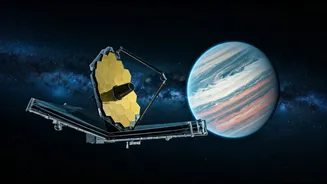
About 190 light-years away in the constellation Ursa Major, there is a planet named HD 80606 b. At a glance, it might seem familiar; it's a gas giant about four times more massive than our own Jupiter. But that’s where the similarities end. Astronomers
haven't discovered it because it's a potential home for life—far from it. Instead, HD 80606 b is famous for having one of the most bizarre and elongated orbits ever discovered. While the planets in our solar system travel in nearly perfect circles, this one travels on a path so stretched out it resembles the orbit of a comet more than a stable planet. This strange journey is the secret ingredient behind its violent and chaotic climate.
A Slingshot Around a Star
Imagine a stretched rubber band. That’s the shape of HD 80606 b’s orbit, a path scientists call highly “eccentric.” For most of its 111-day year, the planet drifts far away from its host star, lingering in the cold, distant parts of its system. But then, gravity takes hold and pulls it back in for a dramatic and terrifyingly close pass. As it nears its star, the planet accelerates, whipping around it at incredible speed before being flung back out into the darkness. This orbital slingshot brings it far closer to its star than Mercury is to our sun, subjecting it to an incredible surge of heat and energy before it retreats again. Earth's orbit, by contrast, is so stable and nearly circular that our distance from the sun barely changes, a key factor in our planet's stable climate.
Weather That's Literally Explosive
The result of this orbital dance is weather that is almost unimaginably violent. As HD 80606 b makes its close approach to its star, its atmosphere is flash-heated. In a period of just six hours, the temperature can skyrocket from around 800°C to over 1200°C. This sudden blast of energy, over 800 times stronger than what it normally receives, effectively causes the atmosphere to explode. The shockwaves from this heating create storms that rage across the planet with wind speeds estimated to top 17,000 kilometres per hour. Scientists using NASA's Spitzer Space Telescope were able to watch this process in real-time, observing the formation of one of the fiercest storms in the galaxy as a massive hot spot bloomed on the planet.
A Laboratory for Extreme Climates
Studying a world as hostile as HD 80606 b isn't just about cosmic sightseeing. Planets like this are crucial for testing and refining our understanding of how atmospheres work under extreme conditions. They are often called 'hot Jupiters', gas giants that are either very close to their star or, like HD 80606 b, in the process of migrating inward from a more distant, eccentric orbit. Observing how its atmosphere absorbs and sheds heat so rapidly gives scientists invaluable data for their climate models. It helps them understand the physics of planetary heating, storm formation, and atmospheric circulation on a scale that is impossible to replicate. This helps explain not just extreme worlds, but also the delicate balance that makes a planet like Earth habitable.