



A Day Longer Than A Year
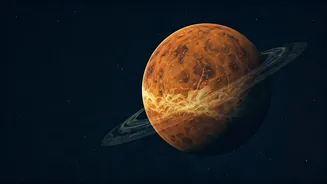
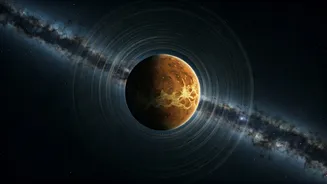
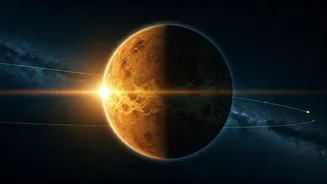
Let's break down the numbers, because they are truly staggering. Venus takes about 225 Earth days to complete one full orbit around the Sun; that's its year. [5] However, it takes a whopping 243 Earth days for Venus to complete a single rotation on its axis,
which defines its day. [5, 7] This means that if you were standing on Venus, you would finish a full trip around the Sun before the planet has even finished spinning once. This is a concept completely alien to our experience on Earth, where our planet’s rotation (a day) is a tiny fraction of its orbit (a year). The result is a bizarre cycle where the sun rises on Venus only once every 117 Earth days. [5, 6]
Spinning The Wrong Way
As if a day being longer than its year wasn't strange enough, Venus also spins backwards. [7] Nearly every planet in our solar system, including Earth, rotates on its axis in a counter-clockwise direction. This is known as prograde rotation. Venus, however, spins clockwise, a motion scientists call retrograde rotation. [18] This means if you could somehow survive on the surface and see through the thick clouds, you would watch the Sun rise in the west and set in the east, the complete opposite of what we see on Earth. [5, 7] This backward spin, combined with its incredibly slow speed, makes Venus a true celestial oddity.
A Cosmic Tug-of-War
So, why is Venus so slow and spinning the wrong way? Scientists don't have one single confirmed answer, but there are several leading theories. [10] One popular idea is that early in its history, Venus was struck by a massive object, perhaps the size of a small planet. [7, 20] Such a cataclysmic impact could have been powerful enough to not just slow its rotation but completely reverse it. [12, 16] Another compelling theory involves Venus's incredibly thick atmosphere. Some scientists believe that gravitational forces from the Sun, acting on the planet's dense atmosphere, created strong atmospheric tides. [13, 20] Over billions of years, this powerful atmospheric drag, combined with friction between the planet's mantle and core, could have slowed the planet’s spin to a halt and then slowly caused it to start spinning in the other direction. [9, 10, 19] It's possible both an ancient impact and atmospheric forces played a role. [9, 12]
The Harshest Planet Next Door
This slow rotation has profound consequences for the planet's environment. Often called Earth's "sister planet" due to its similar size and mass, Venus is anything but hospitable. [2] Its atmosphere is about 93 times denser than Earth's, creating surface pressure equivalent to being nearly a kilometre deep in our ocean. [1, 2, 4] This thick blanket of mostly carbon dioxide has triggered a runaway greenhouse effect, trapping heat and sending surface temperatures soaring to an average of 467 degrees Celsius—hot enough to melt lead. [1, 4, 8] Unlike Earth, there is very little temperature difference between day and night because the dense atmosphere is so efficient at distributing heat around the planet. [8, 13] This extreme climate is a direct result of its atmospheric composition, a condition likely exacerbated by its unique rotation.
An Alien World of Extremes
Venus’s slow, backward spin also likely prevented it from generating a protective global magnetic field like Earth's. [9] Without this magnetic shield, the solar wind has been stripping away lighter elements from its atmosphere for billions of years, including any water the planet may have once had. [9] Everything about Venus, from its inverted day-year cycle to its crushing, toxic atmosphere, paints a picture of a world that could not be more different from our own. It serves as a fascinating case study in how planetary evolution can take wildly different paths, even for planets that started out as near-twins. The strange truth of its rotation is a stark reminder that our solar system is filled with wonders that defy our everyday expectations.