


The Sun’s Volatile Temperament
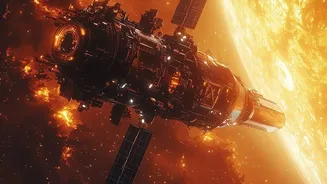
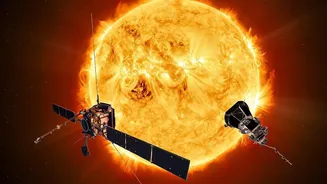
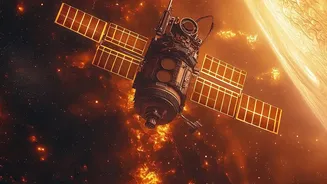
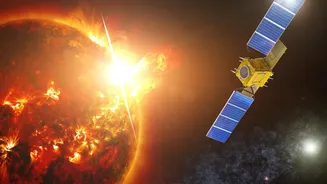
Space weather refers to the changing conditions in space, driven primarily by the sun. Two major phenomena are of concern: solar flares, which are intense bursts of radiation, and coronal mass ejections (CMEs), which are massive clouds of charged particles
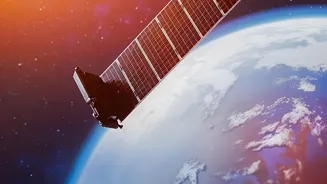
hurled into space. When directed at Earth, these events can wreak havoc on satellites. The onslaught of charged particles can damage sensitive electronics, corrupt data by flipping digital bits, and cause electrostatic discharges that can short-circuit entire systems. Additionally, geomagnetic storms heat and expand Earth's upper atmosphere, increasing the drag on satellites in low Earth orbit. This can cause them to lose altitude and, in severe cases, lead to premature re-entry, as happened to a batch of Starlink satellites in 2022.
A Global Network of Watchers
No single nation can effectively monitor the vastness of space alone. Protection relies on a coordinated global effort. The central hub for this collaboration is the International Space Environment Service (ISES), a network of space weather service-providing organizations from around the globe. ISES includes more than 20 Regional Warning Centres (RWCs) located in countries like the United States, China, Australia, Japan, and India, as well as the European Space Agency (ESA). Key players include NOAA’s Space Weather Prediction Center (SWPC) in the U.S., which serves as the World Warning Agency, and ESA's Space Weather Service Network. These centers operate 24/7, using a combination of ground-based observatories and dedicated spacecraft like the GOES and DSCOVR satellites to keep a constant eye on the sun.
How the Collaboration Works
The strength of the international network lies in constant data sharing. Each regional center collects data from its unique instruments and geographical vantage point, then shares it across the ISES network. This creates a comprehensive, continuous picture of solar activity. When one center detects a potentially hazardous event, like a large CME, it issues alerts and forecasts that are rapidly disseminated to all partners. This coordinated communication ensures that satellite operators worldwide receive timely warnings. This cooperation extends to major space agencies; for instance, a recent agreement between ESA and the Indian Space Research Organisation (ISRO) expanded their collaboration to include joint space weather monitoring and data exchange.
From Forecast to Protective Action
Once a warning is issued, satellite operators spring into action. The specific measures depend on the satellite's design and orbit, as well as the nature of the threat. For a severe radiation storm, operators might temporarily power down non-essential or particularly sensitive instruments to prevent electrical damage. This is often referred to as putting the spacecraft into a "safe mode." If the threat is increased atmospheric drag from a geomagnetic storm, operators of satellites in low Earth orbit can use onboard thrusters to boost their altitude and counteract the drag. For navigation and communication satellites, operators might need to update software or reroute data traffic to maintain service reliability during the storm. These proactive measures are crucial for minimizing damage and ensuring the longevity of billion-dollar assets in orbit.
Future Challenges and Innovations
The task of protecting our space assets is growing more complex. The proliferation of mega-constellations in low Earth orbit means there are far more satellites at risk, and a collision caused by an unpredicted orbital change could create a cascade of dangerous debris. Forecasters also face challenges in accurately predicting the internal magnetic structure of a CME, which is a key factor in its potential to cause a geomagnetic storm on Earth. To meet these challenges, the global community is investing in new technologies. Future missions like the Space Weather Follow On (SWFO) will provide even better early warnings. Researchers are also increasingly using artificial intelligence and machine learning to analyze vast datasets and improve the accuracy and lead time of forecasts, aiming to build a more resilient shield for our technological society.