


The Cosmic Dust Problem
Imagine trying to watch a sculptor at work while they are hidden behind a thick, swirling cloud of dust. That's the fundamental challenge astronomers have faced for decades when trying to observe planetary formation. Young stars are surrounded by massive,
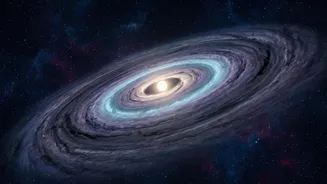
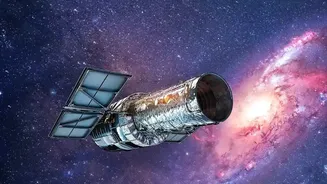
spinning clouds of gas and dust called protoplanetary disks. It is within these chaotic disks that dust grains clump together, growing into pebbles, then boulders, and eventually entire planets. The problem is that this same dust, the very building block of planets, is opaque to telescopes that see in visible light, like the Hubble. It effectively creates a cosmic curtain, shrouding the most crucial moments of a planet's birth from our view, leaving many theories about the process unconfirmed.
Webb’s Infrared Superpower
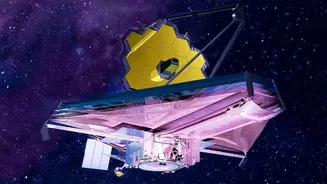
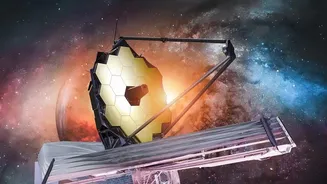
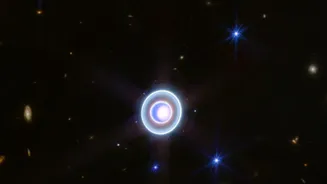
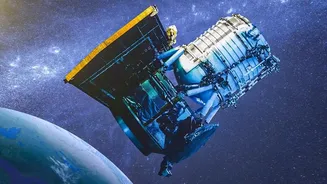
This is where the James Webb Space Telescope’s technological genius comes into play. Webb is designed to see the universe in infrared light. Unlike visible light, which has shorter wavelengths, infrared light has longer wavelengths that can pass through dense clouds of cosmic dust more easily. Think of it like the difference between fog and a heavy curtain; while you can't see through the curtain, some light might penetrate the fog. Webb’s powerful instruments, particularly the Mid-InfraRed Instrument (MIRI), can detect the faint heat glow from these dust-enshrouded regions. This allows astronomers to effectively pull back the cosmic curtain and witness the physical and chemical processes happening deep inside these stellar nurseries for the first time.
A New View of Stellar Nurseries
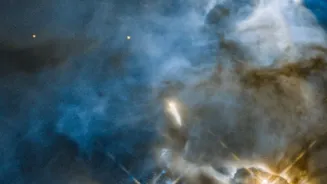
Armed with its infrared vision, Webb is already delivering revolutionary data. By pointing the telescope at young, sun-like stars, astronomers are getting an unprecedented look at the composition of protoplanetary disks. In one recent study, observations with MIRI revealed a surprising abundance of hydrocarbons, including molecules like benzene, in the regions where rocky planets are expected to form. Another groundbreaking discovery was the first detection of water vapor in the inner part of a disk that is already known to host at least two young planets. Detecting water in this terrestrial, planet-forming zone provides crucial evidence that the essential ingredients for life as we know it are present right from the very beginning of a planet's assembly.
Rewriting the Rules of Planet Birth
These new details are forcing scientists to refine, and in some cases rethink, long-standing theories. For instance, recent studies of 72 young stars showed that the material in these disks is blown away by stellar winds much faster than previously thought, suggesting planet formation is a frantic race against time. Gas giants like Jupiter, in particular, must form their massive atmospheres very quickly before this raw material is lost to space. Furthermore, observations are helping scientists map the chemical inventory of these disks. By detecting molecules like carbon dioxide, methane, and various organic compounds, Webb is creating a menu of the ingredients available for building new worlds. This helps explain the incredible diversity of planets found across the galaxy, from hot gas giants to potentially habitable rocky worlds.
From Distant Galaxies to Our Own Solar System
While Webb is looking at star systems hundreds of light-years away, its findings have profound implications for understanding our own cosmic backyard. The telescope is even studying icy bodies in the distant reaches of our own solar system to compare them with the planet-forming conditions seen around other stars. Recent Webb observations have challenged ideas about how the earliest building blocks of planets, called planetesimals, formed. By understanding the chemical makeup and dynamics of these distant, young systems, scientists can piece together a more complete story of how our own Earth and its neighbors came to be. Each discovery of water, carbon, or a specific disk structure in a remote galaxy adds another piece to the puzzle of our own origins, connecting us to the vast, ongoing process of creation across the universe.