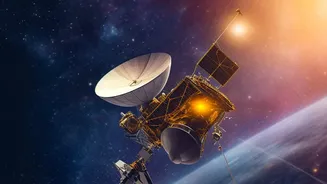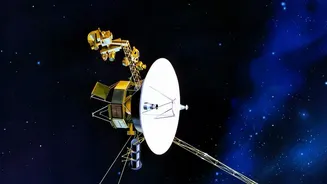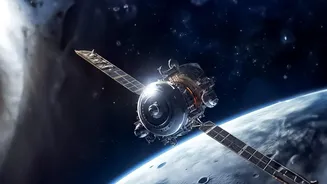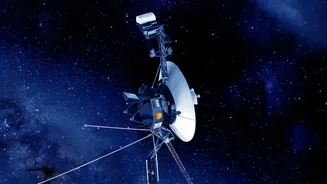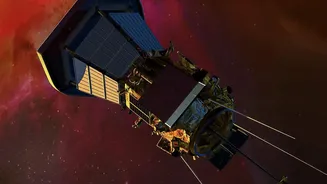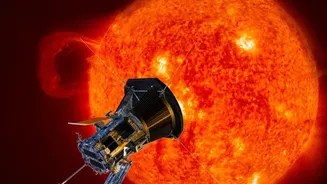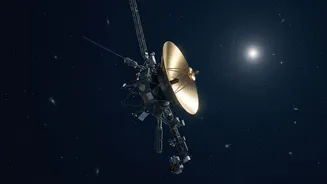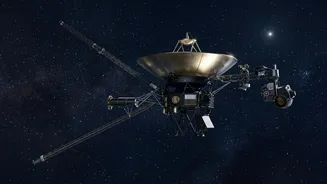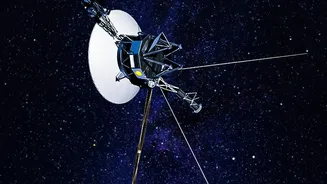

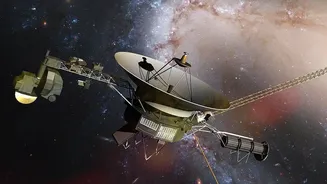
Launched nearly 50 years ago, NASA’s Voyager 1 spacecraft is a ghost from another era. Yet, it continues to speed away from us, now approaching a staggering milestone: a distance of one light-day from Earth, the farthest any human object has gone.
A Journey of Almost 50 Years
On November
18, 2026, a machine built when the world was a very different place will achieve something unprecedented. Voyager 1 will be one light-day away from its home planet. This means it will take a full 24 hours for a radio signal, traveling at the speed of light, to cover the 25.9 billion kilometres separating the probe from NASA's antennas. The one-way communication lag is a mind-bending illustration of the scale of space. It has taken the spacecraft 49 years to travel a distance that light covers in a single day. Launched on September 5, 1977, its original mission was to study Jupiter and Saturn, a task it completed with flying colours by 1980. But its journey was far from over. After its planetary encounters, it became humanity's first interstellar explorer, officially crossing into the space between stars in August 2012.
An Engineering Marvel from the 70s
The longevity of Voyager 1 is a testament to its robust, deceptively simple design. Its computers have just 69 kilobytes of memory, a tiny fraction of the power in a modern smartphone, yet they continue to execute commands sent from billions of kilometres away. This durability comes from a 1970s design philosophy that prioritized reliability and redundancy over raw power. Critical systems were duplicated, and the probe was shielded to withstand the intense radiation of deep space. Power comes not from solar panels, which would be useless so far from the Sun, but from a radioisotope thermoelectric generator (RTG), which converts heat from decaying plutonium into electricity. This nuclear battery has allowed Voyager to keep phoning home, although its power output decreases by about four watts each year.
Keeping a Legend Alive
Keeping a half-century-old spacecraft operational is a constant challenge. In recent years, NASA engineers have performed remarkable feats of remote maintenance. To conserve the dwindling power, they have been strategically shutting down instruments and heaters. In September 2026, engineers completed a delicate manoeuvre nicknamed the 'Big Bang', swapping out older components for lower-power alternatives to extend the life of the remaining science instruments. The mission has had its share of scares, including a recent 48-hour communication blackout in October 2026 that resolved itself before the ground team could even intervene. These efforts ensure that Voyager 1’s two remaining active instruments—a magnetometer and a plasma wave subsystem—can continue to send back valuable data from interstellar space.
Humanity's Message in a Bottle
Attached to the side of Voyager $1$ is the 'Golden Record', a $12$-inch gold$-plated copper disk that serves as a time capsule from Earth. Conceived by a committee led by famed astronomer Carl Sagan, the record contains sounds and images selected to portray the diversity of life and culture on our planet. It includes greetings in $55$ languages, music from artists as varied as Bach and Chuck Berry, and $116$ images of scientific diagrams, human life, and Earth's landscapes. The record's cover includes a pulsar map to pinpoint our solar system's location and instructions on how to play it. While the chances of it being found by an alien civilization are infinitesimally small, the Golden Record is a profound statement of hope and a monument to human curiosity.
The Silent Journey Ahead
Even after this light$-day milestone, Voyager $1$'s journey will continue. It is currently speeding toward the Oort Cloud, a theoretical sphere of icy objects at the outermost edge of our solar system, which it will take about $300$ years to reach. Its power is expected to finally run out sometime in the $2030$s, at which point its signal will fade, and it will go silent forever. But its voyage will not end. As a silent ghost ship, it will continue to coast through the Milky Way galaxy for millions of years. In about $40$,$000$ years, it will have a distant encounter with another star, Gliese $445$. It will drift on, a silent testament to a species that, for a brief moment, reached out from its 'Pale Blue Dot' to touch the cosmos.