






The Brains Behind the Controls
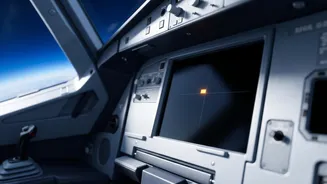
At the heart of a modern airliner’s stability is its flight control system. Many of today's aircraft, like the Airbus A320 family, use a 'fly-by-wire' (FBW) system. Instead of direct mechanical linkages like cables and pulleys connecting the pilot's yoke
or sidestick to the control surfaces on the wings and tail, FBW translates the pilot’s actions into electronic signals. These signals go to flight control computers, which then command actuators to move the surfaces. This system doesn't just replicate the pilot's input; it refines it. The computers can automatically make subtle adjustments to maintain stability and are programmed with safety envelopes to prevent the pilot from making a maneuver that would put the aircraft in a dangerous state. It’s a partnership where the pilot expresses intent, and the computer helps execute it in the safest, most efficient way.
The Power of Redundancy
A core principle in aircraft design is redundancy, which means critical components and systems are duplicated. Nothing essential for flight exists in a single form. Commercial airliners often have triple redundancy for vital systems like flight controls and navigation. This means there are three independent systems performing the same function. If one system fails or provides faulty data, the other two can override it, ensuring the correct action is taken. This applies to hydraulic systems, which power the flight controls, landing gear, and flaps. A large jet might have three separate hydraulic systems, allowing the plane to be flown safely even if two of them fail. Electrical power is similarly protected, with engine-driven generators, an Auxiliary Power Unit (APU), and even a small, drop-down propeller called a Ram Air Turbine (RAT) that can generate emergency power from the airflow itself.
The Human Element: Training for the Unthinkable
Technology is only half the equation. The other half is the highly trained flight crew. Pilots undergo countless hours of training for emergencies, many of which they will likely never encounter in their careers. A critical part of this is Crew Resource Management (CRM), a training framework that emphasizes teamwork, communication, and decision-making in the cockpit. CRM teaches pilots and cabin crew to work as a cohesive unit, using all available resources—people, procedures, and technology—to manage a situation. In an emergency, one pilot is typically designated the 'Pilot Flying' (PF), whose sole job is to maintain control and fly the aircraft. The other pilot, the 'Pilot Monitoring' (PM), handles checklists, communicates with air traffic control, and works to diagnose and solve the problem. This division of labor ensures the aircraft’s flight path is never compromised while the emergency is being managed.
When Systems Work Together
Consider an engine failure, one of the most practiced emergencies. Pilots are alerted by cockpit warnings, and their training immediately kicks in. They maintain control, fly the aircraft, and work through their checklists to secure the failed engine. Even with one engine out, a modern twin-engine jet is designed to fly and climb safely. An aircraft's glide ratio, or its ability to fly without engine power, is also impressive; a Boeing 747, for instance, can glide for about 25 nautical miles for every 10,000 feet of altitude. In the rare case of a total loss of power, as with Air Canada Flight 143 in 1983 which ran out of fuel, the crew’s skill in gliding the aircraft to a safe landing demonstrated how a combination of aircraft design and human expertise can overcome even catastrophic failures. The aircraft's inherent aerodynamic stability, coupled with the crew's precise energy management, ensures control can be maintained.