




Our Invisible Dependence on the Stars
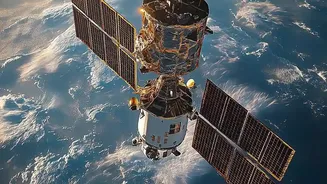
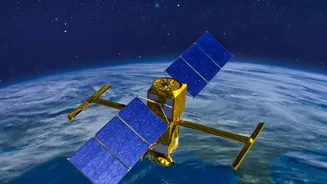
It’s easy to overlook, but satellites form the backbone of modern society. In India and across the globe, Global Positioning System (GPS) satellites don't just guide our cars; their precise timing signals are essential for financial markets, power grids,
and mobile phone networks. They enable credit card transactions at remote shops, provide internet to rural communities, and give farmers the data for precision agriculture. Weather forecasting, disaster management, and global shipping all rely on this constant stream of data from orbit. A thought experiment by solar physicist Pål Brekke, called 'A Day Without Satellites', suggests that a major outage wouldn't be an instant catastrophe, but a slow, creeping breakdown of the systems that keep our world in sync, from air traffic control to emergency services.
A Crowded and Dangerous Sky
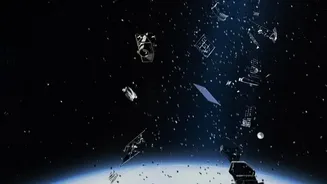
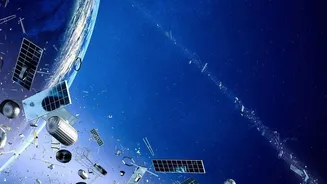
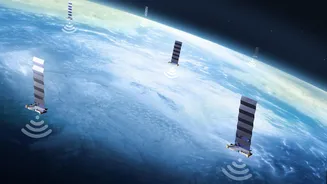
The space around our planet is becoming dangerously congested. Low Earth Orbit (LEO) is now home to tens of thousands of trackable objects, including over 13,000 active satellites. This number has skyrocketed in recent years, driven by the launch of commercial 'mega-constellations'. With more traffic comes a higher risk of collision. The greater threat, however, is the cascading effect known as the Kessler Syndrome, first proposed by NASA scientist Donald Kessler in 1978. This theory posits that if the density of objects in orbit becomes too high, a single collision can create a cloud of debris. Each piece of that debris then becomes a projectile that can strike other satellites, creating even more debris in a chain reaction that could render certain orbits unusable for generations.
The Simulation's Stark Warning
Recent research has brought the abstract threat of orbital collapse into sharp focus. One recent simulation modelled the hypothetical detonation of a one-megaton nuclear weapon in low Earth orbit. The results were catastrophic. While the initial blast would cause damage, the primary threat comes from the swarm of electrons released, which would get trapped by Earth's magnetic field to form a persistent, artificial radiation belt. According to the simulation, this radiation would disable approximately 98 percent of all LEO satellites within a single week. The loss of maneuverability for these disabled satellites is projected to trigger around 20 further orbital collisions within two years, kicking off the dreaded Kessler Syndrome and polluting the environment for any new replacement satellites. While a nuclear event is an extreme scenario, it highlights the interconnected and fragile nature of the entire system.
What 'Satellite Resilience' Actually Means
In response to these growing risks, governments and private industry are now intensely focused on the concept of 'satellite resilience'. This isn't just about building tougher, radiation-hardened satellites. True resilience is about creating a 'system of systems' that can withstand shocks and maintain service. A key takeaway from the recent Space Summit for a Resilient Future is that resilience is now defined by the ability to maintain essential services, not just protect individual satellites. This involves building redundancy into the network with hybrid satellite and terrestrial systems, ensuring different satellite constellations can work together, and developing capabilities for rapid recovery after an incident. For many operators, resilience is about having genuinely diverse connectivity paths, so that if a terrestrial fibre cable is cut, a satellite link can seamlessly take over.
The Global Race for Solutions
The good news is that the industry is actively working on solutions. Advanced simulation software is now used to model debris fields, predict collision probabilities, and help satellites perform avoidance manoeuvres, which numbered over 300,000 in 2025 alone. Companies are developing ambitious technologies for 'in-orbit services', including satellite inspection, refuelling, and relocation to extend the life of valuable assets. Perhaps most critically, there is a major push for active debris removal. These efforts, along with better international agreements on responsible space conduct and post-mission satellite disposal, are seen as essential to prevent the Kessler Syndrome from becoming an inevitability. The focus is shifting from simply launching more hardware to sustainably managing the orbital environment as a whole.